
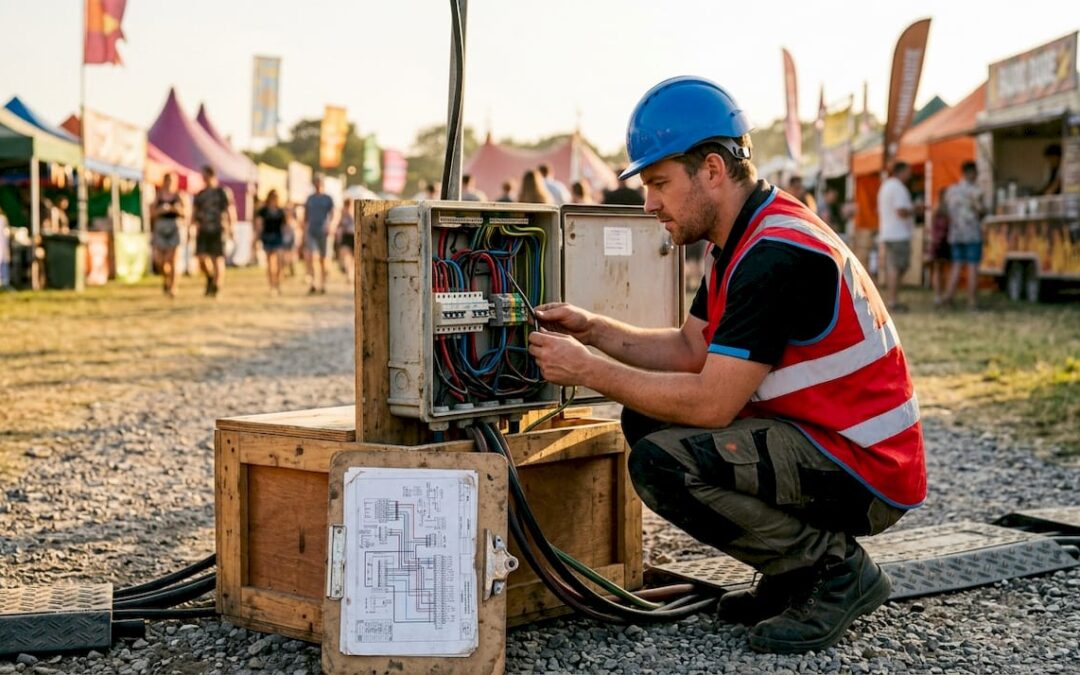
Event distribution board installation is the process of safely designing, installing, verifying, and certifying temporary power distribution systems to supply reliable electricity across event sites. In the UK, all temporary electrical systems must comply with BS 7909:2023+A1:2024, the authoritative code of practice for temporary electrical systems at events and locations. A second standard, BS 7671:2018+A2:2022, governs the technical requirements for wiring and protection devices. Getting both right is not optional. A competent person must design, install, and certify the entire system before a single member of the public sets foot on site.
What does event distribution board installation require?
Event distribution board installation is the regulated process of bringing temporary power from a source, typically a generator or mains supply, through a distribution board and out to every zone of your event site. The industry term for this equipment is a temporary power distribution system, though event planners commonly call the central unit a distribution board or distro. Both terms are correct, and you will encounter both when speaking to electrical contractors.
The competent person role sits at the heart of every compliant installation. This individual designs the system, oversees physical installation, carries out testing, and signs the completion certificate. Without that signature, your event has no legal proof of electrical safety. The Electricity at Work Regulations 1989 require this documentation before public access is permitted.
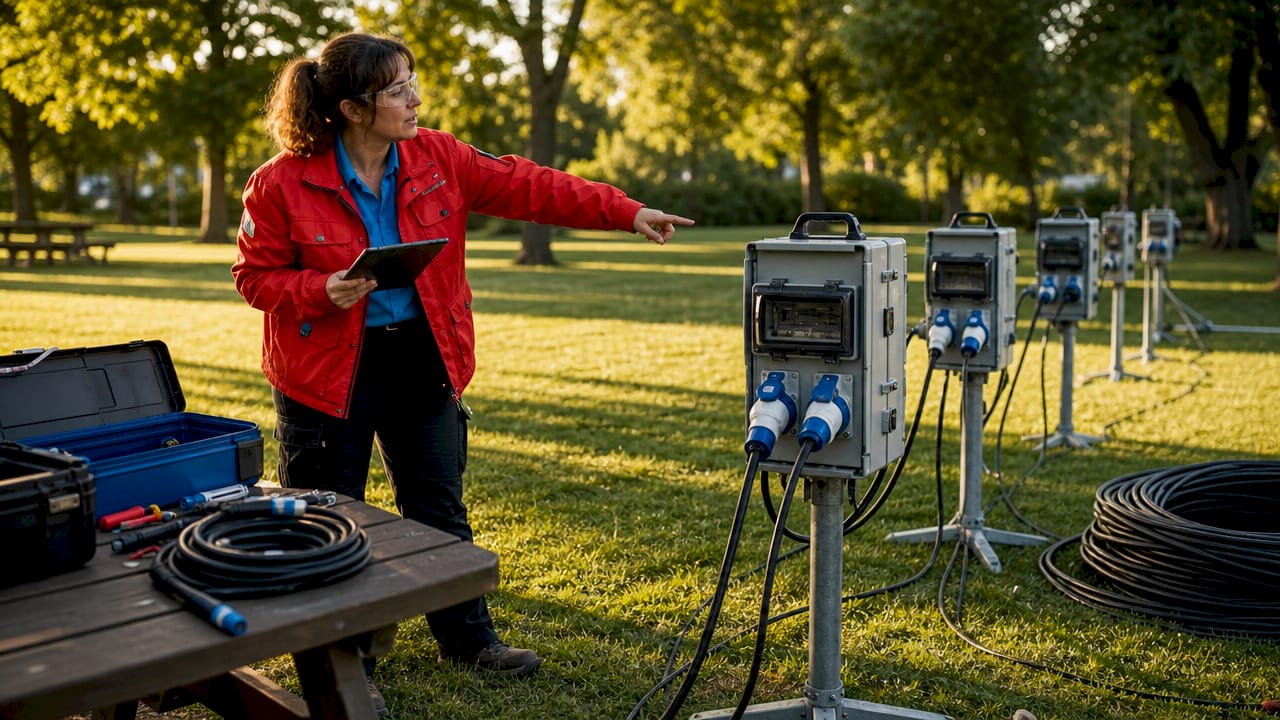
Event organisers often assume temporary setups require lower safety standards than permanent buildings. Temporary systems carry identical requirements to permanent installations, and in many respects face higher risk because of outdoor exposure, unfamiliar sites, and large public gatherings.
What do you need before installation begins?
Preparation separates a safe installation from a dangerous one. Before any cable is laid or board is connected, three things must be in place: the right people, the right equipment, and a thorough site assessment.
Appointing the right person
A Responsible Person must be appointed in writing before installation begins. This is a legal requirement under BS 7909:2023+A1:2024, not a formality. The appointed individual carries legal accountability for the entire installation. Appointing them late creates gaps in liability and compliance that no amount of paperwork can fix after the fact.
Essential equipment checklist
The following equipment forms the core of any compliant event electrical setup:
- IP-rated distribution boards: minimum IP44 for sheltered outdoor use, IP65 for fully exposed sites
- RCD protection devices: 30mA sensitivity for all circuits serving public areas
- Industrial CEE connectors: required for all power runs; domestic 13A plugs are prohibited in critical circuits
- Heavy-duty cable ramps: mandatory wherever cables cross public walkways or vehicle routes
- Armoured or rubber-sheathed cables: sized correctly for the load and run length
- Overcurrent protection devices: circuit breakers rated to match each circuit’s design load
| Equipment item | Minimum specification | Typical application |
|---|---|---|
| Distribution board | IP44 (sheltered), IP65 (exposed) | Central power hub for all zones |
| RCD protection | 30mA trip sensitivity | All circuits with public access |
| Connectors | Industrial CEE, minimum IP44 | All power connections on site |
| Cable ramps | Heavy-duty, load-rated | Walkways and vehicle crossings |
| Cables | Rubber-sheathed or armoured | All runs from board to load |
Site risk assessment
Power load calculations must be completed before any equipment is ordered. Add up the wattage of every item drawing power, apply a diversity factor, and size your distribution board accordingly. Environmental factors matter just as much. Generators must be positioned away from public access areas and food preparation zones due to carbon monoxide risk. Weather forecasts must be monitored throughout the planning period, and the installation plan must be reassessed if conditions change significantly.
Pro Tip: Design your power distribution layout at the same time as your site map. Placing the distribution board after the site layout is fixed almost always creates cable run problems and safety compromises.
How do you install an event distribution board step by step?
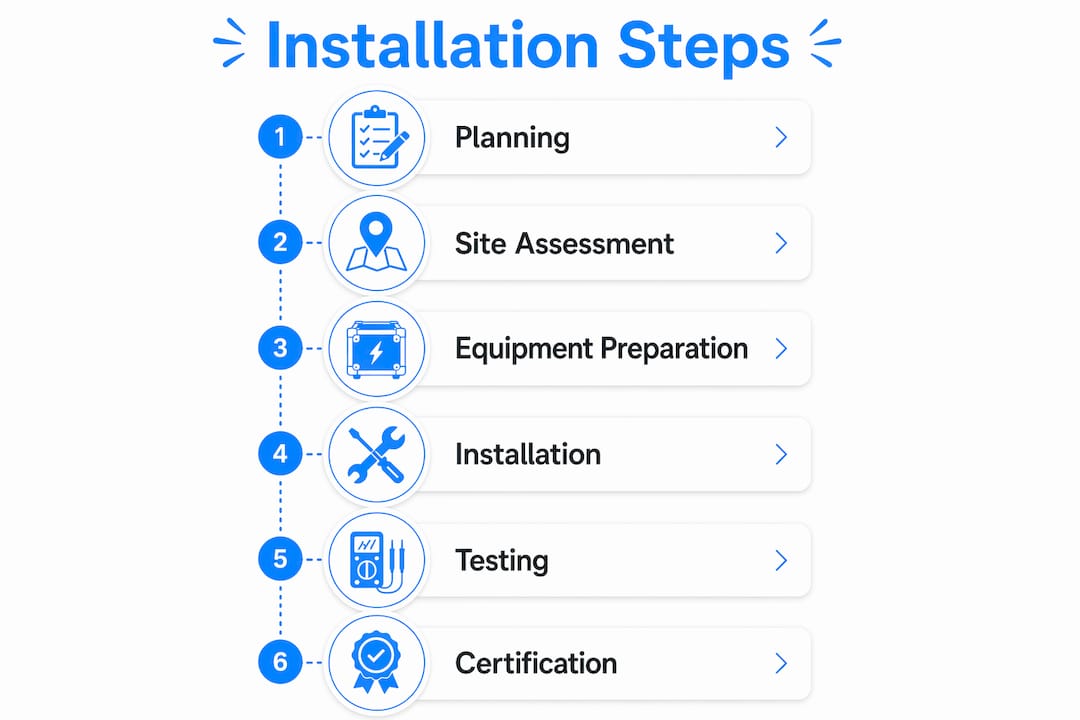
A compliant installation follows a clear sequence. Skipping steps creates faults that are difficult to trace and dangerous to leave unresolved.
-
Produce a written scheme of work. Document the system design, including zoning, load calculations, cable routes, and protection specifications. This document forms part of the compliance record.
-
Position the distribution board correctly. Place it on a stable, level surface. Keep it clear of public thoroughfares, water runoff paths, and vehicle routes. Secure it so it cannot be knocked or moved during the event.
-
Lay and protect all cables. Route cables along the edges of walkways where possible. Where cables must cross public paths, use cable ramps rated for the load. Never run cables under matting or carpet where damage goes undetected.
-
Unwind cable drums fully before use. Fully unwound cable drums prevent heat buildup in the coiled sections. A drum left partially wound during use can overheat, degrade insulation, and cause a fire. This is one of the most common hidden hazards in event installations.
-
Connect industrial CEE connectors throughout. Industrial CEE connectors are mandatory for all event power runs. Never daisy-chain domestic 13A extension leads. They are not rated for sustained high loads and create serious fire and shock risks.
-
Install RCD and overcurrent protection. All circuits must carry 30mA RCD protection as a minimum. RCDs disconnect supply within milliseconds of detecting a fault current, preventing electrocution. Pair each RCD with a correctly rated circuit breaker to protect against overload.
-
Balance loads across phases. For three-phase systems, distribute loads as evenly as possible across all three phases. Unbalanced loading causes voltage instability and can damage sensitive equipment such as audio systems and lighting rigs.
-
Test and commission the system. Carry out insulation resistance tests, RCD trip time tests, and earth continuity checks. Record every result. The competent person then issues a completion certificate confirming the system meets BS 7671:2018+A2:2022 and BS 7909:2023+A1:2024.
Pro Tip: Carry out a full load test before the event opens. Run all circuits simultaneously and check for voltage drop. The maximum permitted voltage drop under BS 7671:2018+A2:2022 is 5%, which equals 11.5V on a 230V supply. Anything beyond that signals a design or connection problem.
The event power risk management process does not end at commissioning. Keep the completion certificate and all test records on site throughout the event. Inspectors and insurers may request them at any point.
How do you troubleshoot faults and maintain safety during the event?
Even a well-installed system can develop faults during an event. Knowing what to look for and how to respond keeps your event running and your audience safe.
Common faults and their causes
- RCD tripping repeatedly: usually indicates a genuine earth fault on the circuit. Do not simply reset and continue. Isolate the circuit, identify the faulty load, and remove it before restoring power.
- Voltage drop beyond 5%: caused by undersized cables, excessive run length, or overloaded circuits. Redistribute loads or add a secondary distribution point closer to the affected zone.
- Overheating connectors: a sign of a loose connection or an overloaded circuit. Isolate immediately. Overheating connectors are a fire risk.
- Insecure cable routing: cables that have been disturbed by foot traffic or vehicles. Re-route and re-protect before continuing.
Monitoring during the event
Assign a named person to walk the site at regular intervals and check cable routes, connector security, and distribution board condition. Weather changes and site modifications are the two most common triggers for mid-event electrical problems. If rain intensifies, check that all IP-rated enclosures remain sealed and that water is not pooling near the distribution board.
Documentation is not a bureaucratic exercise. A formal completion certificate evidencing inspection, testing, and compliance must be issued prior to public access as proof under the Electricity at Work Regulations 1989. The paper trail is the most common failure point during post-incident inspections and the first thing an insurer will request.
Keep a written log of any faults, resets, or modifications made during the event. This record supports any post-event review and demonstrates due diligence if an incident is later investigated.
What are the types of event distribution boards?
Different types of event distribution boards suit different event sizes and environments. Choosing the wrong type wastes money or, worse, creates a system that cannot safely carry the required load.
Single-phase distribution boards
Single-phase boards draw power from one phase of the supply and distribute it across multiple circuits. They suit smaller events: private parties, corporate receptions, and outdoor markets where total load stays below roughly 100 amps. They are lighter, simpler to connect, and easier to transport.
Three-phase distribution boards
Three-phase boards draw from all three phases of a supply and can carry significantly higher total loads. They are the standard choice for festivals, large outdoor shows, and events with heavy stage or catering power demands. Jakspartypower supplies 125 amp three-phase distribution boards suited to large-scale event use.
| Board type | Typical load capacity | Best suited for | IP rating range |
|---|---|---|---|
| Single-phase | Up to ~100A | Small events, private functions | IP44 to IP65 |
| Three-phase (63A) | Medium loads | Mid-size events, corporate shows | IP44 to IP65 |
| Three-phase (125A) | High loads | Festivals, large outdoor events | IP65 recommended |
Custom versus off-the-shelf solutions
Off-the-shelf distribution boards work well for standard event configurations. Custom boards make sense when your event has unusual zoning requirements, non-standard connector types, or very high load demands. The key selection criteria are: total load in kilowatts, number of circuits required, exposure to weather, and whether the board needs to be portable or fixed for the duration.
- For events with mixed catering and entertainment loads, choose a board with separate circuit groups for each zone.
- For fully outdoor events with no shelter, specify IP65 as a minimum on every enclosure.
- For events where the board must be moved between days, prioritise boards with integrated handles and compact form factors.
Key takeaways
Compliant event distribution board installation requires a written scheme of work, a formally appointed Responsible Person, and a completion certificate issued before public access.
| Point | Details |
|---|---|
| Regulatory compliance is non-negotiable | All temporary event electrical systems must meet BS 7909:2023+A1:2024 and BS 7671:2018+A2:2022. |
| Appoint the Responsible Person first | Written appointment must happen before installation begins to avoid legal accountability gaps. |
| Use industrial connectors throughout | CEE connectors and fully unwound cable drums are mandatory; domestic extension leads are prohibited. |
| Match board type to event scale | Single-phase suits small events; three-phase boards are required for festivals and large shows. |
| Documentation protects you legally | Test certificates and completion records must be on site before public access and throughout the event. |
What I have learned from 40 years of event power installations
The single biggest mistake event organisers make is treating power as the last item on the planning list. I have seen it repeatedly. The site layout is finalised, the catering positions are fixed, the stage is positioned, and then someone asks where the distribution board goes. At that point, every cable run is longer than it needs to be, every route crosses a public path, and the competent person is being asked to certify a system that was never designed. It creates unnecessary cost, unnecessary risk, and unnecessary stress.
The second mistake is underestimating documentation. Organisers sometimes view the completion certificate as a box-ticking exercise. It is not. The Electricity at Work Regulations 1989 give that certificate legal weight. If something goes wrong and you cannot produce it, you have no defence. I have seen events shut down mid-afternoon because an inspector arrived and the paperwork was not on site.
My strongest advice is this: bring your electrical contractor into the planning conversation at the same time you bring in your site manager. Treat power planning for outdoor events as infrastructure, not logistics. The cost of getting it right at the design stage is always lower than the cost of fixing it on the day.
— Rob
How Jakspartypower supports your event power setup
Jakspartypower brings over 40 years of electrical contracting experience to every event power project in Sussex and beyond. The team supplies certified, IP-rated distribution boards for hire, from single-phase units for private functions to 125 amp three-phase boards for large outdoor shows. Every piece of equipment meets current BS 7909 and BS 7671 standards.

Flexible hire terms mean you can specify exactly the boards, cables, and connectors your event requires without committing to permanent purchases. Jakspartypower also offers a standby service, with a qualified engineer on site throughout your event to monitor the system and respond to any fault immediately. For event planners who want reliable, compliant power without managing the technical complexity themselves, that combination of certified equipment and on-site expertise is the practical solution.
FAQ
What standard governs event distribution board installation in the UK?
All temporary event electrical systems in the UK must comply with BS 7909:2023+A1:2024, supported by BS 7671:2018+A2:2022 for wiring and protection requirements. A competent person must design, install, and certify the system before public access.
Do I need a completion certificate for a small private event?
Yes. The Electricity at Work Regulations 1989 require a formal completion certificate for any temporary electrical installation, regardless of event size. The certificate must be on site before guests arrive.
What RCD protection is required for outdoor event circuits?
All outdoor and temporary circuits must carry 30mA RCD protection as a minimum under BS 7671:2018+A2:2022. RCDs disconnect supply within milliseconds of detecting a fault, preventing electrocution.
Can I use domestic extension leads at an event?
No. Domestic 13A extension leads are prohibited for critical event power runs. Industrial CEE connectors must be used throughout, and all cable drums must be fully unwound before use to prevent thermal damage.
When should I choose a three-phase distribution board?
Choose a three-phase board when your event has high total power demands, such as festivals, large outdoor shows, or events with significant stage and catering loads. Single-phase boards suit smaller functions where total load stays within their rated capacity.