
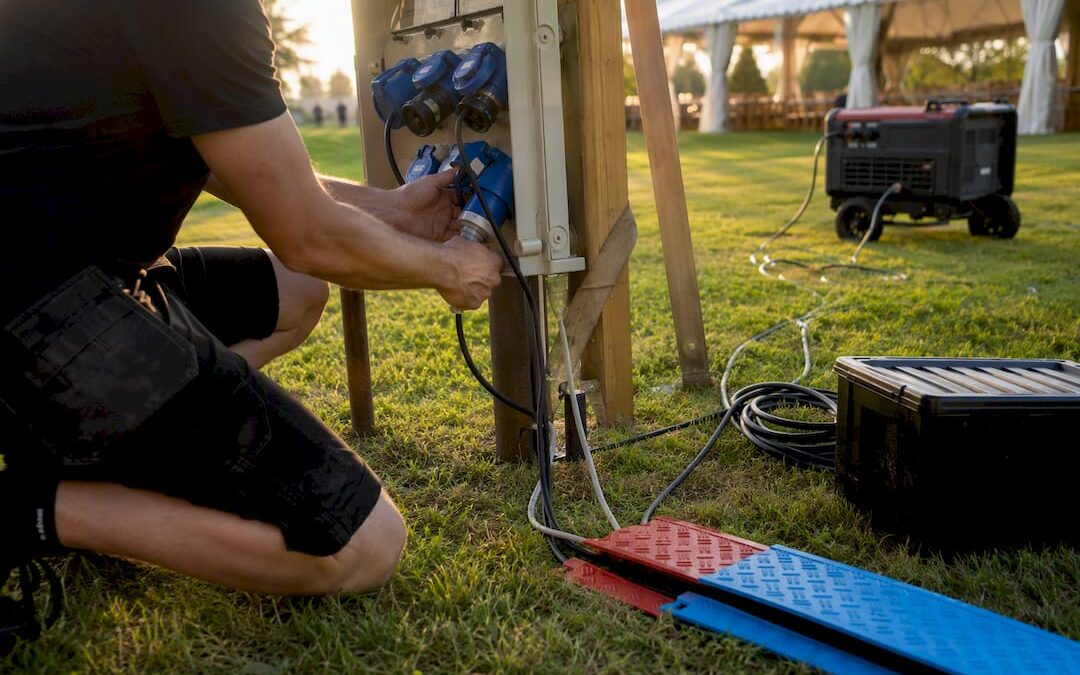
The most common wedding power mistakes are avoidable: an undersized generator, no named Senior Person Responsible (SPR), badly routed cabling, bypassed earthing or RCD protection, no pre-event testing, and no standby plan. Each one causes a genuine event failure most weekends across the UK, and each has a one-line fix.
- Wrong generator size → Build a load schedule first, then size the generator to run at 50 to 75% of rated capacity.
- No SPR appointed → Name one competent person, in writing, before the site survey happens.
- Poor cable routing → Use ramps on pedestrian routes and armoured or ducted runs where vehicles pass.
- Earthing and RCDs ignored → Test every RCD on site; never remove or bypass one to stop nuisance tripping.
- No testing before doors open → Insist on PAT tags, generator test runs and a written handover.
- No standby power → Keep a spare inverter or UPS for front-of-house and a technician on call.
- Unlicensed or inexperienced suppliers → Ask for evidence of BS 7909 competence before booking.
- No emergency isolation plan → Label the main isolator and brief venue staff on where it is.
Pro Tip: If you only fix one thing, fix this: appoint an SPR and have them sign off a tested load schedule before the wedding day. Almost every other failure on this list traces back to one of those two steps being skipped.
Key Takeaways
| Point | Details |
|---|---|
| Appoint an SPR | Name a competent person under BS 7909 before the site survey, not after. |
| Build a real load schedule | Separate continuous from peak loads and add 20 to 30% headroom above the running total. |
| Never bypass protection | Test RCDs on-site and never remove them to stop a trip; find the fault instead. |
| Plan for failure, not just supply | Keep a standby inverter, UPS or spare generator ready rather than relying on one unit. |
| Work with a competent provider | Jakspartypower runs site surveys, tested generator hire and standby technicians under BS 7909. |
Table of Contents
- What are the most common wedding power mistakes to check before booking?
- Appointing an SPR, running a site survey and building a load schedule
- Which generator mistakes cause outages at weddings?
- How should cabling and distribution boards be routed on site?
- Why do earthing and RCD failures still happen at events?
- What testing and labelling should happen before guests arrive?
- What should you ask a power supplier, and what red flags matter?
- What happens when power actually fails during a wedding?
- Emergency power failure protocols and backup power options
- Coordinating electrical and event staff during setup and the day itself
- Safety briefing and training for non-technical staff
- What twenty years in temporary power teaches you about wedding day risk
- How an experienced provider reduces the risk on your wedding day
- Where to check the standards and guidance behind this article
- Sources
- FAQ
What are the most common wedding power mistakes to check before booking?
Before you sign off on any generator, distribution board or cabling plan, run through a short checklist with your supplier or venue contact. This is the point where most disputes and last-minute panics get prevented, not fixed.
Confirm with your supplier:
- Who is the appointed SPR, and what evidence do they hold of competence under BS 7909?
- Has a written load schedule been produced, covering catering, lighting, band or DJ equipment and heating?
- What IP rating does outdoor equipment carry, and where will earthing points sit?
- Are RCDs fitted at every distribution point, and will they be tested on arrival?
- Where will the generator sit, and does that location clear noise limits and refuelling access?
- Is there a written fuel plan for a full-day or evening event?
- Will you receive test certificates (PAT, generator test run, distribution paperwork) before guests arrive?
Sign-off sequence to expect:
- Site survey completed and documented, ideally weeks before the date.
- Equipment delivered, tested and tagged on arrival.
- Final walkthrough with the venue during the handover window, isolators pointed out.
Keep the generator somewhere accessible for refuelling but away from guest routes, and always know where the emergency isolator sits.
Appointing an SPR, running a site survey and building a load schedule
Under BS 7909, every temporary electrical system at a UK event needs a Senior Person Responsible. This isn’t a box-ticking title. The SPR manages design, supervises installation and answers for compliance with BS 7671, the IET Wiring Regulations, from planning through to strike. For a wedding, that person is usually the electrical contractor’s own competent engineer, not the venue’s events coordinator or the couple’s uncle who “does a bit of wiring.”
A proper site survey, in line with HSE guidance, records mains capacity, overhead lines, buried cables, vehicle access, weather exposure and where intakes and generator enclosures will sit. Skip this and you find out about the low-hanging power line or the marquee pegs sitting over a buried cable on the morning of the wedding, not weeks before.
The load schedule is where most disasters start. List every continuous load (lighting rigs, catering fridges, heaters) separately from peak loads (kitchen equipment firing up together, a band’s PA at full volume), then build in additional headroom above the calculated running total to accommodate peak loads and prevent trips.
Pro Tip: Walk the timetable hour by hour. Catering loads peak differently to evening lighting and dancefloor sound, and a schedule built around a single “worst case” number often misses the actual worst moment.
Reliable power design is a continuous process across the whole event, not a one-off calculation, according to guidance from NAPIT.
Which generator mistakes cause outages at weddings?
Sizing a generator from guesswork rather than a load sheet is the single biggest cause of wedding power outages. The fix starts with the numbers: total your running load, add starting-current surges for motors and compressors, then aim to operate the generator at 50 to 75% of its rated capacity. Run much below that band and diesel units risk wet stacking; run above it and you’re one kettle away from a trip.
Placement causes almost as many complaints as sizing. Generators pushed too close to the marquee for convenience blast noise straight into the speeches, and exhaust routed towards a walkway is a genuine hazard, not just an inconvenience.
- Keep the enclosure accessible for refuelling and servicing, but segregated from guests, with warning signage and weather protection, as HSE guidance recommends.
- Check local noise curfews before confirming the pitch, especially for evening receptions near neighbouring properties.
- Plan refuelling windows around the ceremony and speeches, never mid-event.
Pro Tip: A small standby inverter for the DJ desk or a UPS on front-of-house sound costs far less than an emergency callout mid-reception, and it buys the technician time to fix the real problem without anyone noticing.
How should cabling and distribution boards be routed on site?
Undersized or wrongly rated distribution boards, and residential-grade connectors used at feeder level, cause more trips and blown circuits than any other wiring error at weddings. Every distro board should be rated for the load it carries, with circuits labelled clearly by zone: kitchen, band, lighting, bar.
Cable routing decides whether guests trip over a lead or whether a delivery van crushes one. NAPIT’s guidance is clear that cabling must be protected from mechanical damage and water ingress, which means:
- Cable ramps across every pedestrian route, never gaffer tape and hope.
- Catenary wires or overhead bridges across vehicle routes where cables can’t be avoided.
- Buried ducts at proper depth for permanent or semi-permanent runs, with armoured cable where digging isn’t practical.
- Spare leads kept on-site for a fast swap if a run gets damaged mid-event.
Segregate vehicle access from cable routes wherever the site allows it, and plan the strike sequence before the event starts, not as an afterthought at midnight.
Why do earthing and RCD failures still happen at events?
Effective earthing and bonding across multiple supplies is what stops a single fault becoming a fatality, and it only works when every earthing point is documented and co-ordinated across the whole site, not treated supply by supply.
The most dangerous mistake on any wedding site is bypassing protection to stop nuisance tripping. Removing an RCD from a fused distribution unit (FDU) because it keeps cutting out during the first dance doesn’t fix the fault. It just removes the thing designed to protect guests from it.
- Test every RCD on arrival, and again during the event if conditions change (rain, extra loads plugged in).
- Check earth continuity at each distribution point, not just at the source.
- Keep isolation procedures written down and accessible to the SPR, not just held in someone’s head.
Generator sizing guidance recommends building headroom into the load calculation specifically so protective devices aren’t tempted out of the circuit under pressure, a point event power distribution guidance makes explicitly.
What testing and labelling should happen before guests arrive?
Every circuit needs a test certificate before the first guest walks in: RCD test results, PAT tags on portable appliances, a generator test run under load, and full distribution paperwork handed over to the SPR. Photograph the final setup, isolators included, so there’s a clear record if anything gets queried later.
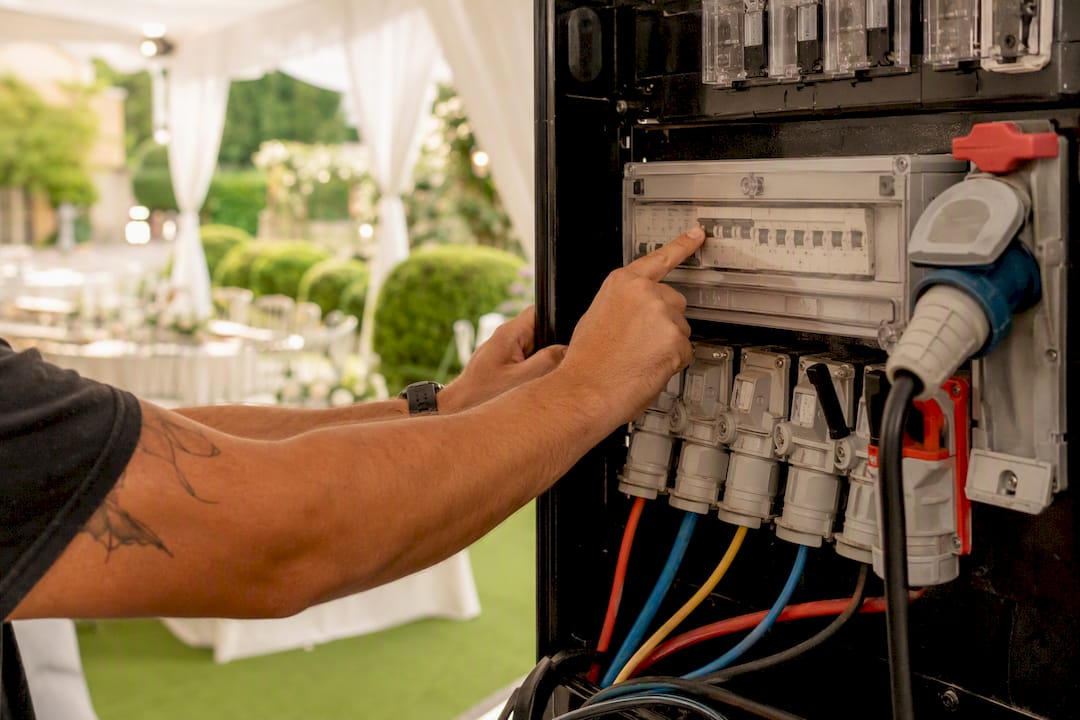
Labelling saves time when it matters most. Every circuit should be marked by zone, every isolator clearly shown to venue staff and the duty holder, so nobody’s searching for a switch during a power cut with 150 guests watching.
Pro Tip: Give the venue’s duty manager a laminated card showing the location of the main isolator and a single phone number for electrical issues. It costs nothing and it’s the difference between a five-minute fix and a stalled reception.
During the event itself, build in scheduled checks: an RCD test at a natural pause, a fuel level check before the evening reception, and a named technician contact circulated to the wedding planner and venue team, not buried in a supplier’s paperwork.
What should you ask a power supplier, and what red flags matter?
Ask for evidence of BS 7909 competence, confirmation of who the SPR will be, proof of insurance, and copies of recent test certificates or EICRs before you book. A supplier who can’t answer these quickly is telling you something.
Questions worth asking directly:
- Who is your named SPR for our event, and what’s their track record?
- Can we see a written load calculation before the deposit is paid?
- What’s your fuel management and standby plan if the main generator fails?
- Will RCDs be tested on-site, with results shown to us?
Red flags to walk away from:
- No willingness to run a site survey before quoting.
- Vague or missing isolation and emergency procedures.
- No proof of trained staff or recent test certification.
- Reluctance to put load calculations in writing.
Set a clear acceptance test and a technician window for soundcheck as part of the contract, not a verbal promise on the day.
What happens when power actually fails during a wedding?
An RCD tripping mid-speech, a generator overloading when the kitchen fires up for the main course, a cable crushed by a delivery van, or a lost neutral bond: these are the four failure modes that show up most often on wedding sites.
The fix depends on speed and restraint in equal measure. Move non-critical loads off the circuit first. Switch front-of-house sound to a UPS while the fault gets traced. Isolate and re-route a damaged cable rather than patching it live. Deploy a spare distribution unit or the standby generator if the primary unit can’t be brought back safely within minutes.
The one rule every competent technician follows on-site: never jury-rig earthing, and never bypass a protective device to buy time. If an RCD keeps tripping, the fault is real. Call a qualified electrician and isolate the circuit until it’s found.
Escalation isn’t a failure of planning; it’s what the planning was for. A named SPR and a documented isolation procedure mean the person on-site knows exactly when to call it, rather than guessing under pressure with the first dance five minutes away.
Emergency power failure protocols and backup power options
A power failure at a wedding isn’t really an electrical problem in the moment. It’s a communication and sequencing problem, and the technical fix usually takes less time than working out who needs to know first.
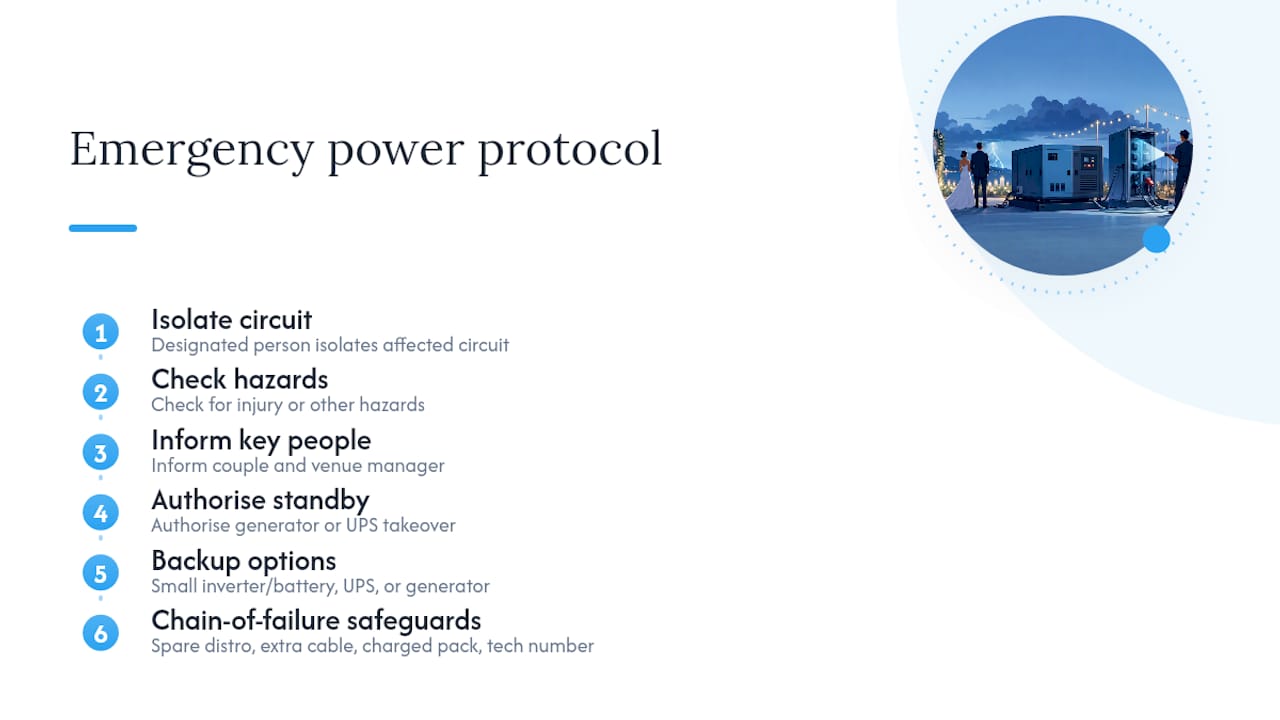
A written emergency protocol should specify, in order: who isolates the affected circuit, who checks for injury or hazard, who informs the couple or venue manager, and who authorises the standby generator or UPS to take over. Without that order agreed in advance, three people often reach for the same switch while nobody tells the band to pause.
Backup options scale with the event’s risk tolerance. A small inverter or battery unit can carry essential lighting and sound for a DJ set through a brief outage. A UPS on front-of-house audio prevents the awkward silence mid-speech while a fault gets traced. For larger weddings, a second generator on standby, sized to at least cover critical loads, means the event barely pauses if the primary unit trips.
The chain-of-failure approach treats standby power as a sequence of small, cheap safeguards rather than a single expensive one. A spare distro board, a few metres of extra cable, a charged battery pack and a technician’s mobile number often prevent more outages than a bigger generator ever would.
Write the protocol down, share it with the venue and the wedding planner before the day, and test the standby equipment once during setup. An untested UPS is a false sense of security, not a backup.
Coordinating electrical and event staff during setup and the day itself
Most on-site electrical confusion doesn’t come from bad equipment. It comes from the electrician, the caterer, the band and the venue manager each assuming someone else is tracking the power plan.
A short pre-event briefing, held during setup rather than rushed at the door, fixes most of this. The SPR or lead electrician should walk the site with the venue duty manager and confirm: where the isolators are, which circuits feed which zones, and what the escalation contact number is if something trips. Experienced planners consistently find that reliable power comes down to confirming sound, lighting and catering requirements against actual power capacity well before the day, not assuming everyone’s plans will simply fit together.
During the event, one point of contact matters more than a long chain of command. Give the venue manager, the wedding planner and the catering lead the same single number for electrical issues, rather than three different suppliers each managing their own circuit in isolation. A shared radio channel or group message thread works well for larger weddings with multiple contractors on site.
Timing matters too. Catering teams need to know when their peak load window is (usually service and plating), so kitchen equipment doesn’t fire up unannounced against a lighting rig running at full capacity for the first dance. A five-minute conversation between the electrician and the caterer during setup prevents most overload trips that otherwise happen mid-reception, right when nobody wants to deal with them.
Safety briefing and training for non-technical staff
Waiting staff, ushers and venue coordinators don’t need to understand three-phase distribution, but they do need to know three things: where the isolators are, what an RCD trip looks like, and who to call if something feels wrong.
A five-minute briefing before doors open covers this. Point out cable ramps and tell staff not to move furniture over them. Show where the main isolator sits, not so they touch it, but so they can direct a technician there instantly during an emergency. Explain that a burning smell, a warm cable, or a flickering light isn’t something to investigate personally. It’s something to report immediately.
Non-technical staff are often the first to notice a problem, simply because they’re moving through the venue constantly while the electrician is stationed at the distribution point. Giving them a clear, simple response (stop, report, don’t touch) turns that early warning into a fast fix rather than a bigger fault developing unnoticed for twenty minutes.
Keep the briefing consistent across every role. A caterer who knows to report a tripped socket to the same named contact as the wedding planner prevents the confusion of multiple people trying to fix the same issue differently. This costs nothing beyond ten minutes during setup, and it’s one of the few genuinely free safeguards available on a wedding site.
What twenty years in temporary power teaches you about wedding day risk
Most wedding power failures I’ve seen trace back to the same root cause: someone tried to save a day or two by skipping the site survey, or skipped naming an SPR because “the electrician will sort it.” Both choices remove the one thing standing between a minor trip and a stalled reception.
I remember one event where a kitchen load spike during service nearly took out the entire marquee circuit. The only reason guests never noticed was a standby inverter, agreed weeks earlier during the load schedule conversation, quietly taking the front-of-house sound while the fault got traced and cleared.
That’s the rule worth remembering: plan for the failure you hope never happens, not just the power you expect to need. Jaks Party Power Limited builds standby and tested solutions around exactly that principle.
How an experienced provider reduces the risk on your wedding day
Getting this right on your own, from load calculations to RCD testing to standby planning, is a lot to ask of a wedding planner or a couple already juggling caterers and florists. Jakspartypower handles the whole chain: site surveys, generator hire sized to your actual load schedule, distribution boards, cabling with proper protection, earthing checks and technicians on call throughout the event.

Every job follows BS 7909 with a named Senior Person Responsible, built on over 40 years of electrical contracting experience. A written quote should always set out the load schedule, equipment list, test certification and standby arrangement before you sign anything, so there are no surprises on the day. If you’re planning a wedding and want power that simply works, get a generator quote and start with a site survey.
Where to check the standards and guidance behind this article
- HSE electrical safety guidance covers legal duties for event organisers, including site surveys and generator segregation.
- BS 7909 sets the compliance framework and SPR requirement for temporary electrical systems.
- BS 7909:2023 code of practice details planning, supply provision and battery storage guidance.
- NAPIT’s technical guidance explains cable protection and installation practice.
Compliance obligations sit with BS 7909 and HSE guidance; sizing bands, headroom percentages and standby strategies are practical best practice built on top of them.
Sources
- Electrical safety – HSE
- Temporary electrical systems for entertainment and related purposes: code of practice (BS 7909)
- Event power distribution guide
FAQ
What is the most common wedding power mistake?
Undersizing the generator or skipping a proper load schedule causes most wedding power failures, usually surfacing as an overload during peak catering or lighting demand.
Do I need a Senior Person Responsible for a wedding marquee?
Yes. BS 7909 requires a named SPR for any temporary electrical system, including wedding marquees, to manage design and compliance with BS 7671.
How big should a generator be for a wedding?
Size the generator from a written load schedule, then aim to run it at 50 to 75% of its rated capacity with 20 to 30% headroom above your calculated running load.
Can I use a residential extension lead for outdoor wedding power?
No. Outdoor and feeder-level connections need correctly IP-rated equipment and properly protected cabling, not household-grade connectors or unprotected leads.
What should I ask a power supplier before booking a wedding?
Ask for evidence of BS 7909 competence, confirmation of the named SPR, written load calculations, and recent test certificates before paying a deposit. Jakspartypower provides all of these as part of a written quote.