
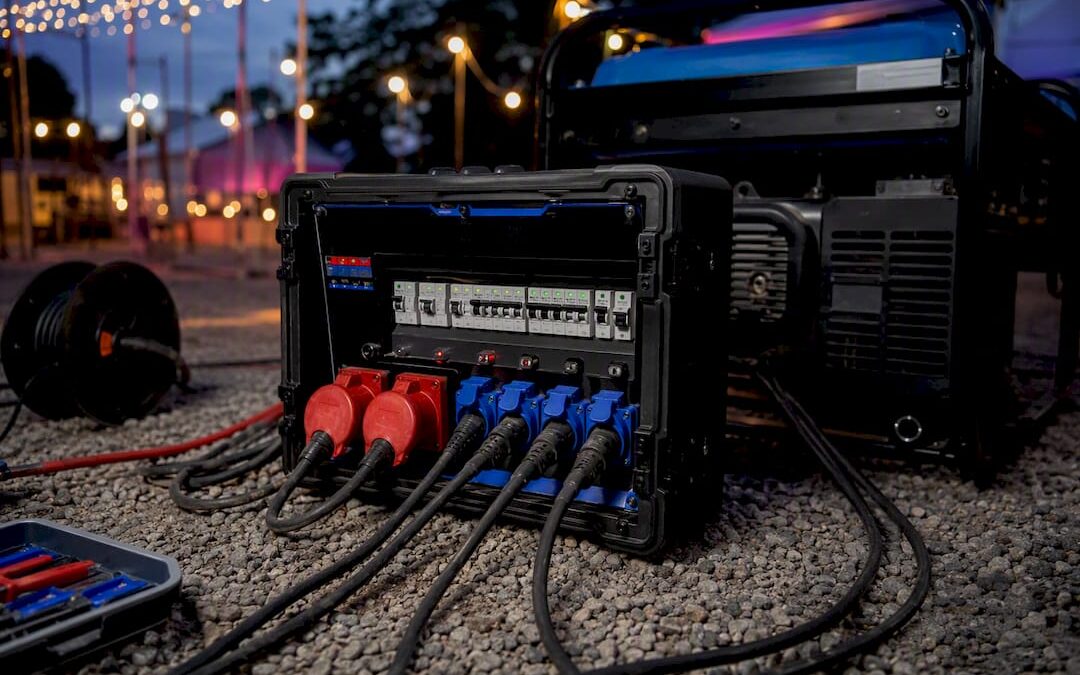
Portable power distribution is the system of equipment that takes a single power source, mains or generator, and safely splits it into multiple controlled circuits for temporary use at events, construction sites, or filming locations. It exists because you rarely have enough fixed sockets where you actually need power, and running raw generator output straight to equipment is a fast route to blown breakers or worse.
A working setup nearly always includes:
- A supply source: mains connection or generator
- A distribution board or PDU (power distribution unit) to split the load
- Circuit breakers and RCDs for protection
- Sockets and outlets rated to the equipment being run
- Cables and connectors matched to distance and current
The whole discipline sits on established ground: BS 7671 is the wiring baseline, BS 7909 governs temporary and event systems specifically, and HSE’s HSG141 fills in the gaps for construction sites.
Key Takeaways
Portable power distribution safely splits one supply into multiple protected circuits, and BS 7909 plus RCD protection are what make temporary systems as safe as permanent ones.
| Point | Details |
|---|---|
| Core definition | Portable power distribution splits one supply source into multiple protected circuits via a distribution board or PDU. |
| Standards apply in full | BS 7671 remains the baseline, with BS 7909 covering temporary and event systems specifically. |
| RCDs are essential | RCD protection is critical on TT earthing systems common at temporary sites, not an optional extra. |
| Planning prevents failures | Load calculation, demand factors, and generator headroom stop most on-site power trips. |
| Professional support closes the gap | Jaks Party Power provides hire, installation, testing, and standby cover across Sussex events. |
Table of Contents
- What is portable power distribution and why does it matter?
- What are the physical parts of a distribution system?
- Which configurations suit different event sizes?
- Where is portable power distribution actually used?
- How do you plan power for a temporary site?
- What safety standards and controls apply to temporary power?
- Should you hire or buy your distribution equipment?
- What does a professional installation actually involve?
- Get your power planned properly, not patched together
- Sources
- FAQ
What is portable power distribution and why does it matter?
Portable power distribution is the practical answer to a problem every event organiser and site manager eventually hits: you have power somewhere, but not everywhere you need it. A generator parked at the edge of a field is useless to a lighting rig 80 metres away unless something safely carries and divides that power along the way.
That “something” is the distribution system. It takes one input, whether that’s a generator or a mains supply, and turns it into several independently protected outputs. Each circuit gets its own breaker, so a fault on the catering tent doesn’t take down the main stage. This matters more than most people expect: BS 7671 still applies in full to temporary installations, not a relaxed version of it, because a fire or shock risk doesn’t care whether the wiring is permanent or up for one weekend.
If you’ve searched “what is power distribution” more broadly, the temporary version follows the same electrical logic as a building’s consumer unit. It just has to be weatherproof, quick to rig, and tough enough to survive being loaded onto a van at 2am after a show.
What are the physical parts of a distribution system?
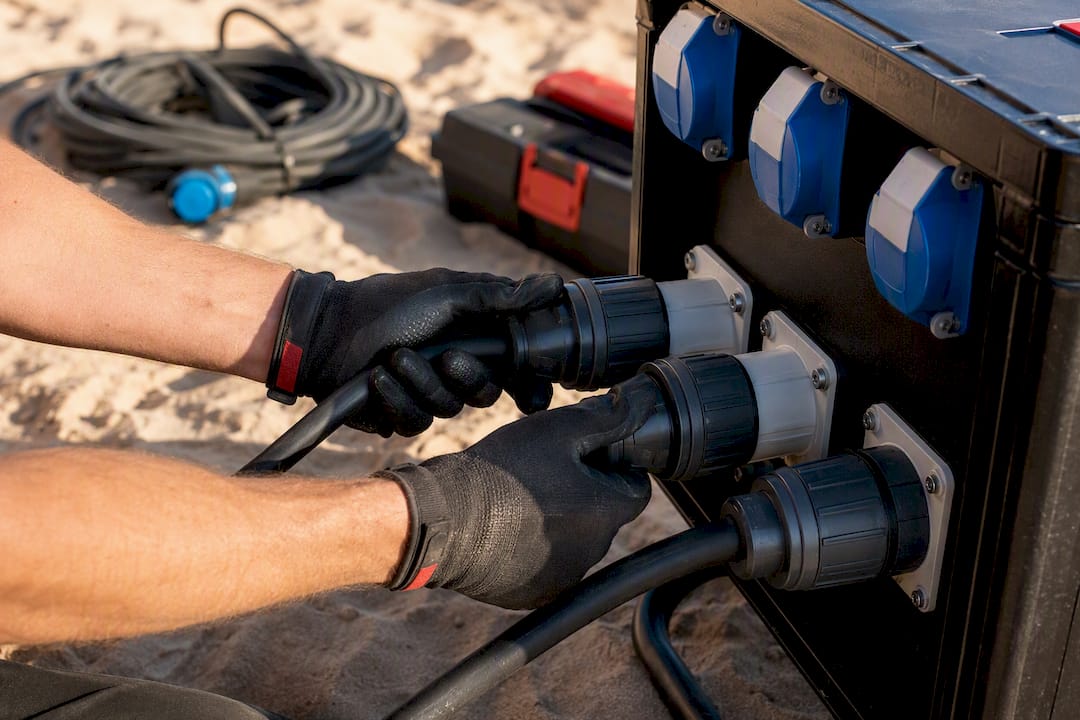
Most systems are built around a distribution board, often housed in a rugged case known in the industry as a tuff box. Inside sits an inlet, busbars to split the current, and a bank of breakers, one per outgoing circuit. Larger events use dedicated PDUs (power distribution units), which are essentially road-cased versions of the same idea, built to take heavy repeated handling. A PDU is designed to accept a single supply and feed dozens of branch circuits from one point, which is exactly why it’s the backbone of most event power setups.
Key components you’ll encounter:
- MCBs (miniature circuit breakers): protect circuits from overload
- RCDs (residual current devices): cut power fast if there’s an earth fault, protecting people rather than just equipment
- Isolators: let you kill power to a section safely for maintenance
- Cables and connectors: rated 16A, 32A, 63A or 125A, in single or three-phase versions
- Camlocks: heavy-duty connectors for high-current three-phase feeds
- Splitters and adapters: convert one outlet into several lower-rated ones
An SPR (Senior Person Responsible) is the named individual accountable for a temporary system under BS 7909, a role worth knowing before you hire anything.
Which configurations suit different event sizes?
Scale dictates configuration. A small networking event with a bar and some uplighting might run comfortably off a single-phase supply through one distribution box rated for typical small event currents. A mid-size festival stage, by contrast, typically needs a three-phase feed and a panel rated at higher currents suitable for larger event loads, split further into sub-boards for lighting, sound, and catering.
Two basic layout patterns come up repeatedly:
- Serial distribution: one main inlet feeds a chain of sub-distribution boards, each handling a zone
- Parallel generator setups: two or more generators run together to cover peak demand or provide redundancy if one fails
Construction sites often favour smaller 32A or 63A boards dotted around the plot rather than one large central panel, since work areas shift as the build progresses. Distribution boards at larger events usually need this kind of tiered approach rather than a single oversized box.
Where is portable power distribution actually used?
You’ll find these systems wherever fixed electrical infrastructure falls short of demand. Common applications include:
- Concerts and festivals, where stage power alone can run into hundreds of kilowatts
- Corporate outdoor events, product launches, and marquee weddings
- Film and TV production, which often needs quiet, clean power away from a location’s mains
- Construction and refurbishment sites, before permanent supply is connected
- Emergency and standby power, covering outages at hospitals or data centres
A small press launch might need one 32A tuff box; a large festival stage can require multiple 400A panels feeding sub-boards. Outdoor exposure, proximity to water, and the age of a venue’s existing supply all change how cautious the setup needs to be.
How do you plan power for a temporary site?
Good planning starts on paper, well before any cable touches the ground. Rushed load calculations are the single biggest cause of tripped breakers mid event.
- List every load on site with its estimated wattage, then add them up, including lighting, sound, catering equipment, and site facilities
- Apply a demand factor, since not everything runs simultaneously, but never assume less than 80% of stated load will draw at peak
- Distinguish real power (kW) from apparent power (kVA), the latter accounting for how efficiently equipment uses current, which matters for generator sizing
- Size the generator with headroom, planning practical guidance on temporary site electrics consistently flags under sizing as the most common and expensive mistake
- Zone the site into sub-boards to shorten cable runs and isolate faults to one area rather than the whole event
- Choose cable and connectors based on current rating, run length (voltage drop increases with distance), and whether it needs outdoor-rated, waterproof housing
Pro Tip: Label every circuit at both ends before doors open, not after. When something trips at 9pm in the dark, a labelled board is the difference between a five-minute fix and a headline incident.
What safety standards and controls apply to temporary power?
BS 7671 remains the baseline for every installation, temporary or otherwise. On top of it, BS 7909 sets out the code of practice specifically for temporary and event electrical systems, including the requirement to appoint an SPR. Construction and demolition sites also fall under HSE’s HSG141 guidance, which supplements BS 7671’s Section 704 for that environment.
Non-negotiable controls include:
- RCD protection on every circuit, since TT earthing arrangements common on temporary sites rely on RCDs rather than overcurrent devices alone for fast disconnection
- PAT testing on all portable appliances before they’re connected
- Correct earthing arrangements verified before the system goes live
- A named competent person or SPR accountable for the whole installation
A basic pre-event checklist: test every RCD with its trip button, verify earth continuity, confirm all connections are weatherproofed, and walk the full cable run before the public arrives. Common venue electrical failures tend to trace back to skipping exactly one of these steps.
Should you hire or buy your distribution equipment?
For most event organisers, hiring wins outright. Distribution boards, generators, and cabling need regular maintenance, safe storage, and periodic testing, costs that add up fast for equipment used a handful of times a year. Types of event power equipment worth hiring versus owning depends largely on frequency of use and available storage space.
When briefing a supplier, ask directly:
- How many outlets, and what current rating, per circuit?
- What RCD and breaker configuration is fitted?
- Is on-site standby support included during the event?
- What testing and certification comes with the equipment?
- Who handles delivery, rigging, and collection?
Generators need careful transport and refuelling protocols; road-cased distribution boards are heavy and awkward without proper handling equipment.
What does a professional installation actually involve?
An experienced crew follows a consistent sequence on arrival, and it’s worth knowing what that looks like even if you’re not doing the work yourself.
- Walk the site to confirm the plan matches the ground reality
- Check earthing arrangements before anything is powered up
- Label every board and circuit clearly
- Verify every RCD trips correctly
- Load-test circuits before the event opens
- Hand over documentation: test certificates, load schedules, and a risk assessment or method statement
Pro Tip: Ask for the test certificate before you sign off, not after the event. If a supplier can’t produce one on the day, that’s your answer about whether to use them again.
Beyond a single extension lead and a lamp, this is not sensible DIY territory. The role of electrical contractors at events exists precisely because the risks scale with the equipment.
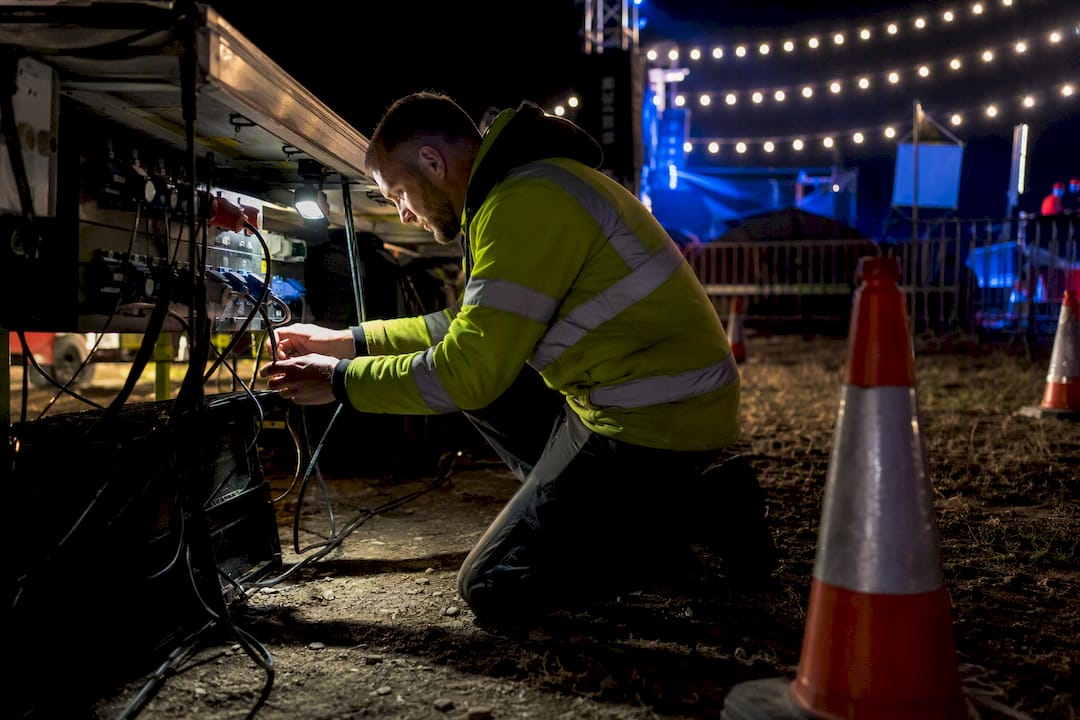
A supplier’s honest view on DIY versus hired power
Small, single-circuit setups with basic loads are fine to manage yourself. The moment generators, three-phase supply, large crowds, or water exposure enter the picture, bring in professional setup and standby cover. Testing and a competent person on hand aren’t optional extras at that scale.
Get your power planned properly, not patched together
Jaks Party Power handles the whole job across Sussex: equipment hire, delivery, installation, full testing, and standby support for the duration of your event, so you’re never troubleshooting a tripped breaker alone at midnight.
Rather than hiring a generator from one place and a distribution board from another and hoping they match, one team designs, tests, and stands by the entire system with over 40 years of electrical contracting experience behind it. That’s the practical advantage over piecing equipment together yourself: one point of accountability, one crew who already know how the parts fit.
If you’re planning an event, get in touch to request a site survey or a quote through the event equipment hire checklist, and get your power scoped properly before the date is locked in.
Sources
For technical detail beyond this guide, consult BS 7671 and BS 7909 directly for standards, HSE HSG141 for construction site guidance, and an event PDU reference for equipment specifics.
- HSE HSG141 guidance (as given in prompt)
- Event Power Distribution Unit parts diagram & bill of materials | BOMwiki
FAQ
What is a portable power distribution box?
It’s a road-cased or tuff-boxed panel that accepts a single power inlet, usually from a generator or mains, and splits it into multiple protected circuits with breakers and outlets.
What are the three types of power distribution?
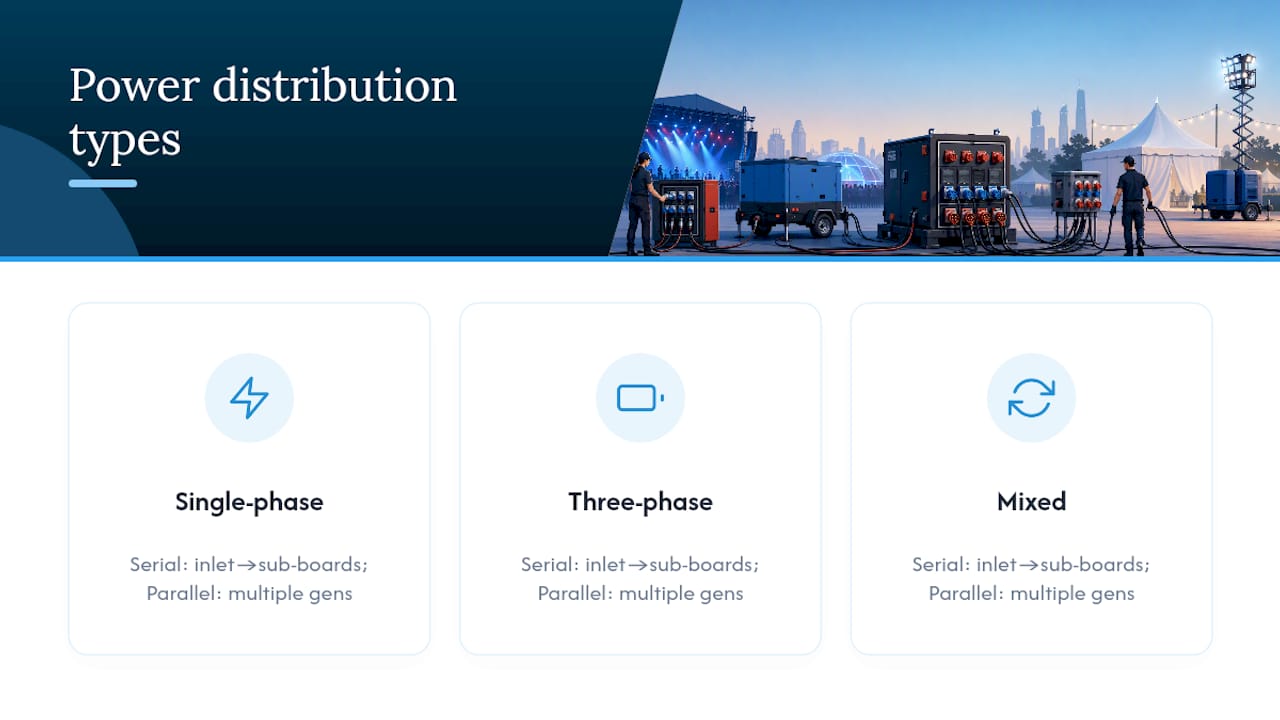
Distribution is generally organised as single-phase, three-phase, or a mix of both depending on load. Layouts fall into serial arrangements (one inlet feeding sub-boards) or parallel setups using multiple generators together.
Can a portable power station run a house?
A small portable power station can run select appliances during an outage, but a full house typically needs a properly sized generator connected through a distribution board designed for the total load, not a plug-in battery unit.
What can you run off a portable power station?
Small units handle lighting, phones, laptops, and low-draw appliances comfortably; anything with a motor or heating element, like a kettle or power tool, needs a proper distribution setup with adequate breaker capacity.