
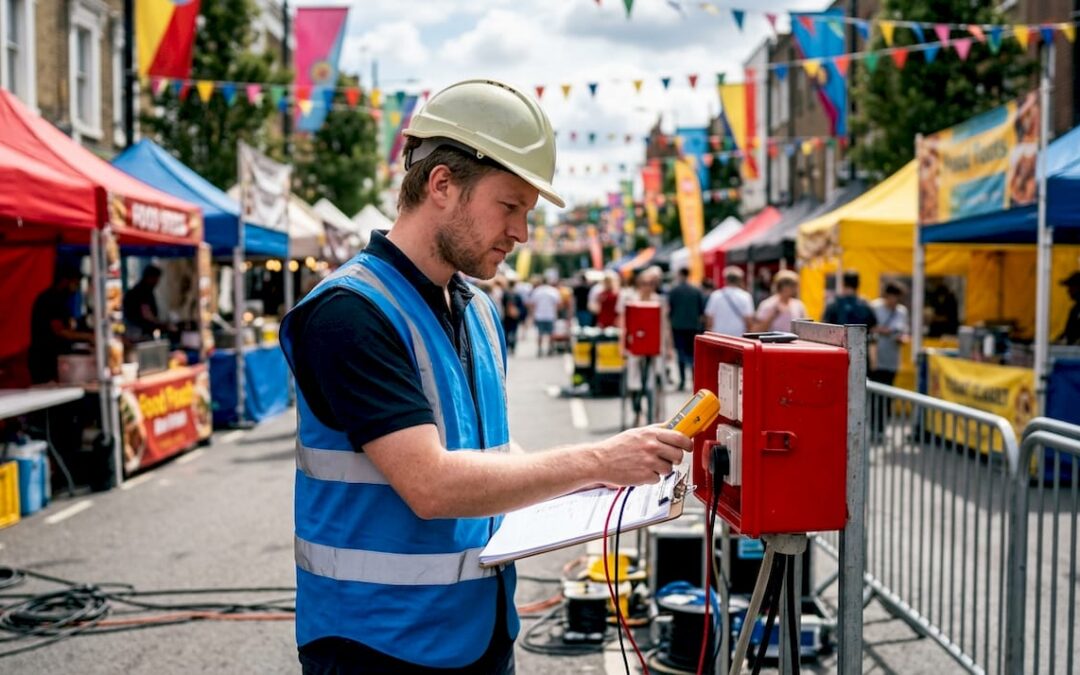
Event electrical equipment inspection is the systematic process of assessing and verifying temporary electrical installations and appliances at events to confirm they are safe and legally compliant. For event organisers, this is not optional. UK law places a direct duty of care on you, and failure to comply with standards such as BS 7909:2011+A1:2020 and BS 7671:2018+A2:2022 can result in prosecution, voided insurance, and serious harm to attendees. Getting this right requires more than a quick visual check. It demands a structured process, qualified personnel, and documented evidence.
What regulations govern event electrical equipment inspection?
UK law sets a clear framework for temporary electrical installations at events. The Health and Safety at Work Act 1974 requires organisers to take all reasonably practicable steps to protect workers and the public. The Electricity at Work Regulations 1989 go further, requiring that all electrical systems are constructed, maintained, and used to prevent danger.
BS 7909:2011+A1:2020 is the Code of Practice specifically written for temporary event electrical systems. It mandates that all temporary installations are designed, installed, inspected, and tested by a competent person, with a documented scheme of work in place before any work begins. Outdoor supplies must have 30mA RCD protection on all circuits and must limit voltage drop to 5% (11.5V at 230V).
BS 7671:2018+A2:2022, the IET Wiring Regulations, underpins all electrical installation work in the UK. It sets the technical requirements that BS 7909 references for protection devices, cable sizing, and earthing.
Key legal obligations for event organisers include:
- Appoint a competent person to design, install, and inspect all temporary electrical systems
- Maintain written records of all inspections and tests, kept for at least 6 years
- Report electrical incidents causing injury to the HSE within 10 days under RIDDOR
- Consult the HSE’s ‘Purple Guide’ as the primary industry reference for event safety
The HSE’s Purple Guide is the industry standard reference for event safety management. Non-compliance with its guidance is treated as evidence of negligence if an incident occurs.
What preparations are needed before inspecting event electrical equipment?
Preparation determines whether your inspection is meaningful or merely a formality. The most common failure point is appointing someone who claims competence but cannot prove it.
Competence means verified qualifications and relevant experience, not verbal assurances. Before any contractor touches your installation, request documentary evidence. City & Guilds 2377 is the recognised qualification for PAT testing personnel. For installation and inspection work, look for qualifications aligned with BS 7909 and a demonstrable track record on similar events.
Preparations to complete before inspection begins:
- Obtain and review all contractor qualifications, training certificates, and insurance documents
- Confirm a written scheme of work and risk assessment exists for the specific installation
- Verify that all cables, connectors, and protective devices are rated correctly for the load and environment
- Check that all equipment meets BS 7909 criteria before the formal inspection starts
- Confirm IP ratings are appropriate for outdoor or wet conditions
Pro Tip: Request copies of contractors’ public liability insurance and their most recent electrical test certificates before they arrive on site. Contracts alone do not transfer your legal liability as organiser.
Event organisers retain legal liability even when contractors are appointed. Contracts do not transfer responsibility for ensuring competence. You must verify qualifications and recent test records before allowing any work to begin.
How to perform a step-by-step inspection of temporary electrical equipment
A thorough inspection follows a clear sequence. Skipping steps or combining them creates gaps that can go undetected until something fails during the event.
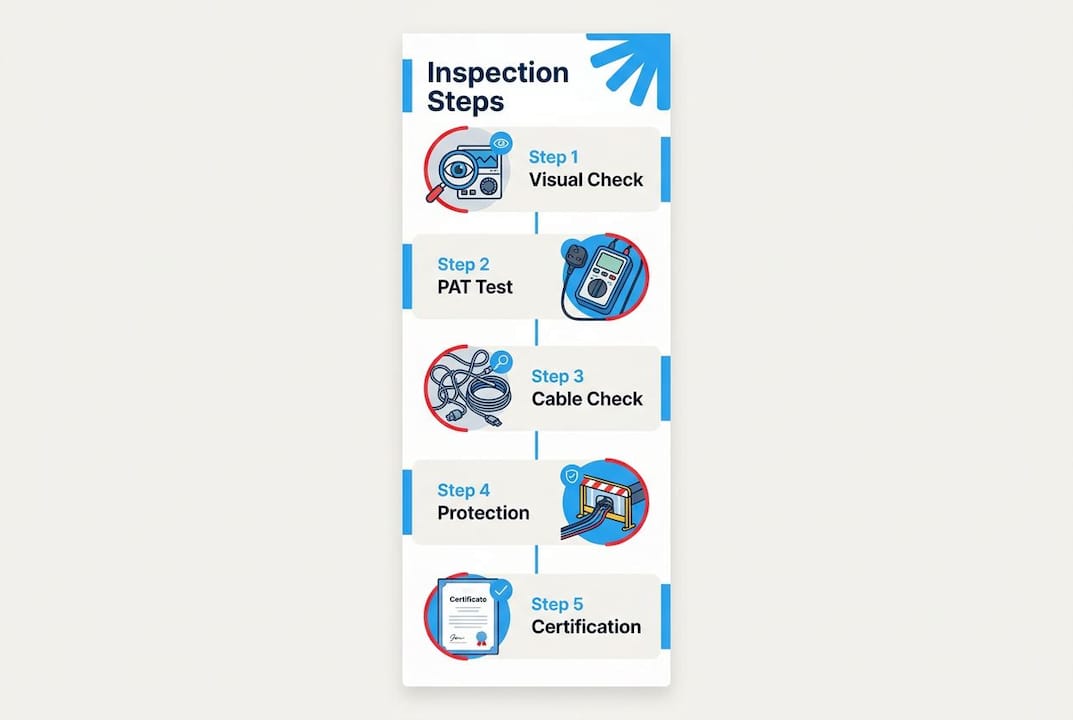
Step 1: Visual inspection
Begin with a detailed visual check of every item in the installation. Look for physical damage to cables, connectors, plugs, and enclosures. Check that cable entries into equipment are properly secured with cable glands. Confirm that all outdoor equipment carries an appropriate IP rating for the conditions. Temporary outdoor systems require higher standards than permanent indoor wiring because of exposure to wet weather and public interaction.
Step 2: PAT testing of portable appliances
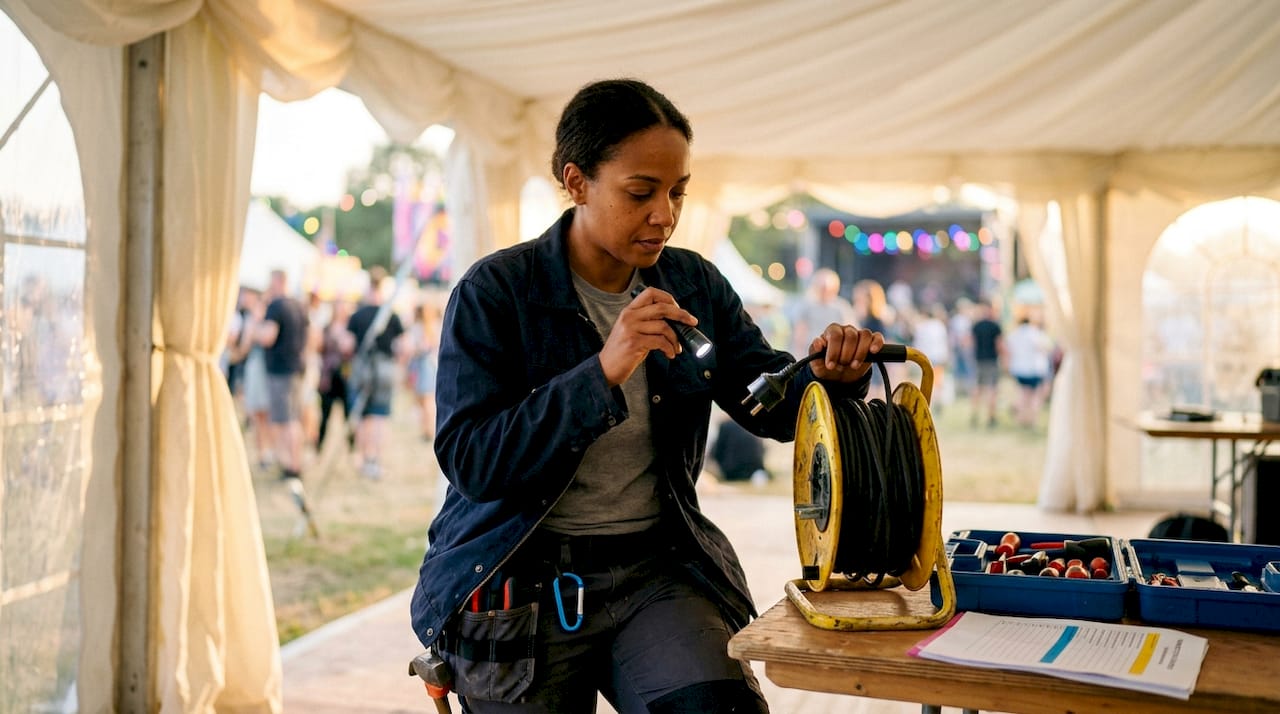
Portable appliance testing (PAT) uses calibrated test equipment to verify the electrical safety of individual items. Every portable appliance used at the event requires a valid PAT test. UK law recommends testing before every use for high-risk environments, with records retained for at least 6 years. Insurance policies frequently require valid PAT records as a condition of cover.
Step 3: Cable inspection and installation checks
Cable inspection is where many organisers underestimate the risk. Check that cable cross-sectional area (CSA) is correctly sized for the current it carries. Never permit daisy-chaining of extension leads or adaptors. The role of cabling in event reliability is critical. A frequently overlooked hazard is coiled cable drums. Cables must be fully unwound during use. Coiled cables trap heat, which can melt insulation and trigger thermal trips or, in the worst case, cause a fire.
Step 4: Verify protection devices
Confirm that all circuits have correctly rated overcurrent protection (fuses or MCBs). Verify that 30mA RCDs are fitted on all circuits as required by BS 7909 and BS 7671. Test each RCD using a calibrated RCD tester, not just the test button on the device itself.
Step 5: Document and certify
Every inspection result must be recorded. Issue an Electrical Installation Condition Report (EICR) or equivalent certificate for the temporary installation. Record PAT test results for every appliance. These documents form your legal defence if an incident is investigated.
| Inspection stage | Key check | Standard reference |
|---|---|---|
| Visual inspection | Damage, IP ratings, cable security | BS 7909, BS 7671 |
| PAT testing | Appliance safety, insulation resistance | BS 7671, HSE guidance |
| Cable checks | CSA, full unwinding, no daisy-chaining | BS 7909 |
| Protection devices | RCD 30mA, MCB ratings | BS 7671:2018+A2:2022 |
| Documentation | EICR, PAT records, scheme of work | RIDDOR, HSE |
Pro Tip: Use a calibrated RCD tester rather than relying on the built-in test button. The button confirms the mechanism works. A tester confirms the trip time meets the legal specification.
What are the most common mistakes in event electrical inspections?
Most electrical incidents at events trace back to a small number of repeated errors. Knowing them in advance is the most effective way to prevent them.
Treating a temporary installation as less critical than a permanent one is the single most dangerous assumption an event organiser can make. Outdoor and temporary systems face harsher conditions, higher public exposure, and greater mechanical stress. They demand more rigorous inspection, not less.
Common mistakes to avoid:
- Assuming outdoor conditions are manageable without IP-rated equipment. Wet weather changes the risk profile entirely. Outdoor electrical systems require RCDs on all circuits and IP-rated cables as standard.
- Failing to verify contractor competence. A signed contract does not confirm qualifications. Always request documentary proof before work starts.
- Leaving cable drums coiled during operation. Heat build-up in coiled drums is a well-documented cause of insulation failure and fire. Full unwinding is the industry standard.
- Missing the electrical sign-off hold point. No area of the event should be open to the public until formal sign-off confirms the installation is safe and energised correctly.
- Failing to keep inspection records. Insurance often depends on producing valid PAT and inspection records. Without them, a claim can be refused and legal liability becomes very difficult to defend.
Understanding common event setup mistakes before build day saves time, money, and, most importantly, lives.
What steps maintain electrical safety compliance during setup and operation?
Compliance is not a single moment. It is a continuous process from the first cable laid to the last piece of equipment packed away.
Integrate electrical inspection hold points directly into your event build schedule. No public access should be permitted until formal sign-off confirms the installation is safe and energisation is complete. This is a non-negotiable hold point, not a suggestion.
Steps to maintain compliance throughout the event lifecycle:
- During setup: Confirm all inspection certificates are signed before energisation. Coordinate directly with your licensed electrician at each stage of the build.
- During the event: Assign a competent person to monitor the electrical installation throughout. Establish a clear fault-reporting process so issues are addressed immediately, not at the end of the night.
- For incidents: Any electrical incident causing injury must be reported to the HSE under RIDDOR. Keep a written log of all faults, near-misses, and corrective actions taken.
- Post-event: Conduct a de-energisation check before dismantling. Inspect all hired equipment for damage before return. Update your inspection records and note any items requiring repair or replacement.
Understanding event power risk management as an ongoing discipline, rather than a pre-event tick-box, is what separates organisers who avoid incidents from those who do not.
Key takeaways
A thorough event electrical equipment inspection requires competent personnel, documented evidence, and formal hold points integrated into the event build schedule before any public access is permitted.
| Point | Details |
|---|---|
| Legal compliance is mandatory | BS 7909, BS 7671, and the Health and Safety at Work Act 1974 all apply to temporary event installations. |
| Competence must be verified | Demand documentary proof of qualifications such as City & Guilds 2377 before contractors begin work. |
| Cable drums must be fully unwound | Coiled drums cause heat build-up that can melt insulation and trigger fires during operation. |
| Hold points prevent incidents | No public access until formal electrical sign-off confirms the installation is safe and energised correctly. |
| Records are your legal defence | Keep PAT test results and inspection certificates for at least 6 years to satisfy insurance and HSE requirements. |
What I have learned from 40 years of event electrical work
The paperwork matters, but it is not the whole story. Over four decades of electrical contracting, the pattern I have seen most often is this: an organiser receives a certificate, assumes the job is done, and never asks a single question about what was actually tested. A certificate signed by someone who lacks genuine experience in temporary event systems is worth very little.
The most effective thing I have seen organisers do is walk the site with the electrician before sign-off. Ask them to explain what each RCD protects, where the main isolator is, and what happens if a circuit trips mid-event. If they cannot answer clearly, that tells you something important. Competence shows up in conversation, not just on paper.
Early sign-off hold points have saved more events than any single piece of equipment. When the electrical inspection is treated as the last item before gates open, it always gets rushed. When it is built into the schedule as a fixed hold point two hours before public access, problems get found and fixed without panic. That one change in planning discipline makes the difference between a safe event and a near-miss.
— Rob
How Jakspartypower supports safe event electrical setups

Jakspartypower has over 40 years of electrical contracting experience behind every hire and every site visit. Based in Sussex, the team supplies generators, distribution boards, and cabling that meet BS 7909 and BS 7671 requirements, along with qualified electricians who understand the inspection process from first principles. Whether you are planning a wedding, a corporate show, or a large outdoor festival, Jakspartypower provides equipment and expertise that hold up under scrutiny. The standby service means a qualified engineer remains available throughout your event, ready to respond if anything needs attention. Contact Jakspartypower to discuss your event’s power requirements and get the right support in place from the start.
FAQ
What is an event electrical equipment inspection?
Event electrical equipment inspection is the formal process of visually checking and testing all temporary electrical installations and portable appliances at an event to confirm they meet BS 7909, BS 7671, and UK health and safety requirements.
How often should event electrical equipment be tested?
UK guidance recommends testing before every use for high-risk or outdoor environments, with records kept for at least 6 years. Insurance policies frequently require valid, up-to-date test records as a condition of cover.
Who is qualified to carry out an event electrical inspection?
A competent person with documented qualifications relevant to temporary event installations must carry out inspections. For PAT testing, City & Guilds 2377 is the recognised standard; installation inspection requires qualifications aligned with BS 7909.
What is a 30mA RCD and why is it required at events?
A 30mA residual current device (RCD) is a safety switch that cuts power within milliseconds if it detects a fault current. BS 7909 and BS 7671 require 30mA RCD protection on all outdoor event circuits because it provides the minimum level of protection against electric shock in public environments.
What records must event organisers keep after an electrical inspection?
Organisers must retain the Electrical Installation Condition Report (EICR) for the temporary installation, PAT test records for all portable appliances, and the written scheme of work. These records should be kept for at least 6 years and must be produced if requested by the HSE or an insurer.