
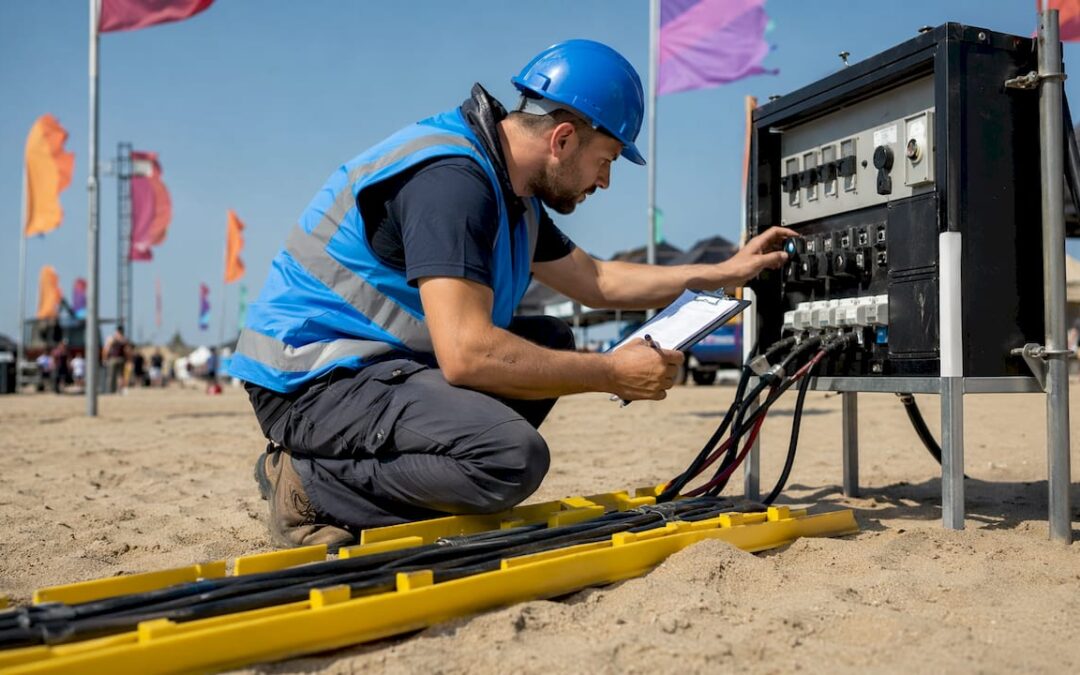
Temporary event power is a specialised electrical system designed to supply safe, reliable electricity for short-term events such as festivals, exhibitions, weddings, and private parties. Unlike a permanent installation, it is built, commissioned, and dismantled around a specific event. The industry term for the governing standard is BS 7909, the Code of Practice for Temporary Electrical Systems, which works alongside BS 7671 (the IET Wiring Regulations). Every event organiser planning a temporary electrical setup needs to understand these frameworks. Getting this wrong is not just a safety risk. It is a legal one.
What is temporary event power and why does it matter?
Temporary event power is defined as any electrical installation erected for a fixed period to support an event, then removed once the event concludes. The IET (Institution of Engineering and Technology) and the HSE (Health and Safety Executive) both treat these installations with the same rigour as permanent systems. The public safety standard is directly linked to the quality of pre-event electrical design and commissioning, not to the word “temporary” in the name.
Events that typically require a dedicated temporary power supply include outdoor music festivals, agricultural shows, wedding marquees, corporate exhibitions, and funfairs. Each of these has different load profiles. A wedding marquee might need lighting, catering equipment, and a sound system. A large show might need stage lighting rigs, multiple catering units, and public address systems running simultaneously.

The critical point is that the temporary label does not reduce legal obligations. Temporary power installations are subject to the Electricity at Work Regulations 1989 and must be designed and maintained to the same standard as permanent systems. Non-compliance risks legal action and event shutdown.
What UK regulations govern temporary event power supply?
The regulatory framework for event power supply in the UK rests on three pillars: BS 7671, BS 7909, and HSE HSG107.
-
BS 7671 (IET Wiring Regulations) sets the baseline for all electrical installations in the UK. It specifies that voltage drop must not exceed 5% (11.5V on a 230V supply) and that all outdoor circuits require at least 30mA RCD (Residual Current Device) protection. These are not optional guidelines. They are mandatory requirements.
-
BS 7909 is the specific Code of Practice for temporary electrical systems at events. It requires a written scheme of work before installation begins. This document defines load distribution, circuit design, and safety margins. A Temporary Electrical Installation Certificate (TEIC) must be issued before the event opens to the public. Testing includes earth electrode resistance, phase rotation, and load capacity verification.
-
HSE HSG107 covers the broader health and safety responsibilities of event organisers. It mandates PAT (Portable Appliance Testing) of all portable equipment and requires risk assessments for generator placement and cable routing. Organisers hold legal responsibility for safety compliance on site, even when they hire specialist contractors.
-
Electricity at Work Regulations 1989 applies to all temporary installations. A competent person, meaning someone with the relevant qualifications and experience, must design, install, test, and certify the system.
-
EN 60309-2 governs the industrial connectors (Commando plugs) used in outdoor temporary power. Compliance with this standard is required for all outdoor connections.
The combined effect of these regulations is clear. An event organiser cannot simply hire a generator, run a cable, and call it done. Every element of the system must be planned, documented, and certified.
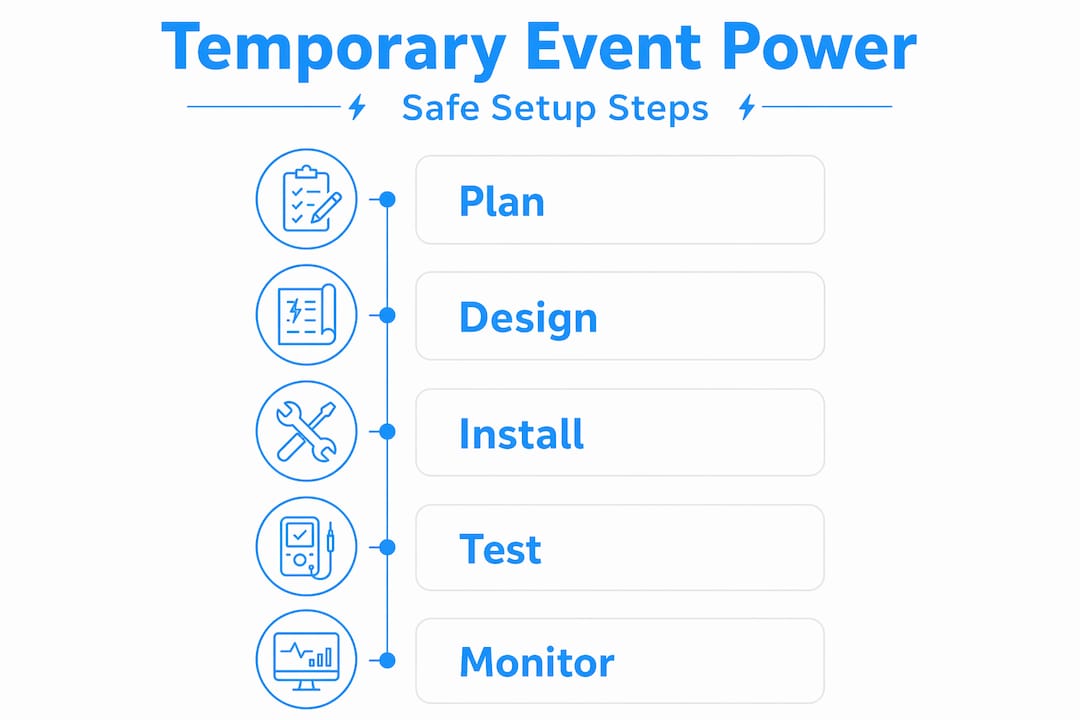
How is temporary event power safely planned and installed?
Safe planning starts with an accurate load calculation. Add up every piece of electrical equipment that will run simultaneously, then apply a 20–25% safety margin to handle startup surges. Load calculations with a safety margin protect against the sudden current spikes that motors and lighting rigs produce when they switch on.
The key steps in planning and installation are:
- Calculate total load. List every appliance, its wattage, and whether it runs continuously or intermittently. Add the figures, then increase the total by 20–25%.
- Select generators appropriately. For larger events, multiple generators distribute load safely and maintain supply if one unit fails. No generator should run above 80% of its rated capacity.
- Plan distribution boards. Portable power distribution boards with RCD protection, circuit breakers, and weatherproof enclosures are the backbone of any temporary electrical setup. Jakspartypower supplies a range of distribution boards for events built to BS 7909 requirements.
- Select cables correctly. Cables must be IP-rated for outdoor use, correctly rated for the current they carry, and routed to avoid trip hazards and mechanical damage. The role of cabling in event reliability is often underestimated by first-time planners.
- Engage a competent person. Design, installation, testing, and commissioning must all be carried out by a qualified electrician with experience in temporary systems.
Pro Tip: Never use domestic extension leads for outdoor event power. They are a fire risk and are prohibited for long outdoor runs under BS 7909. Use IP-rated, industrial-grade Commando plugs compliant with EN 60309-2 for every outdoor connection.
What ongoing safety practices keep event power reliable?
A temporary power system does not become safe once it is switched on. It requires active management throughout the event. RCDs must be tested and visually checked daily due to high traffic and environmental factors. This is a non-negotiable requirement, not a recommendation.
The core ongoing safety practices are:
- Pre-opening testing. Before the public arrives, complete earth electrode resistance tests, phase rotation checks, and load tests. Document every result.
- Daily visual inspections. Walk the site each morning. Check cables for damage, connectors for moisture ingress, and distribution boards for signs of overheating.
- Load monitoring. Watch for circuits approaching their rated capacity. Overloading a circuit does not always trip a breaker immediately. It can cause cables to overheat silently.
- Generator management. Generators must be positioned with adequate ventilation, away from public areas and food stalls, to prevent carbon monoxide build-up. Fuel management and refuelling plans must be in place before the event opens.
- Environmental awareness. Rain, mud, and pedestrian traffic all create new hazards as an event progresses. Cable covers and barriers must be maintained throughout.
Pro Tip: Treat your power plan as a living document. Update it whenever a trader adds equipment or a stage changes its setup. Brief all event staff on the location of isolation points so they can respond quickly if a fault occurs.
The ongoing monitoring of electrical systems throughout an event is what separates a well-run power operation from one that fails at the worst possible moment.
What equipment is used in temporary event power setups?
The equipment used in a temporary electrical setup falls into four broad categories. Understanding each one helps you ask the right questions when hiring or specifying a system.
| Equipment category | Purpose | Key specification |
|---|---|---|
| Diesel generators | Primary power source for off-grid events | Sized to load plus 20–25% safety margin; run below 80% capacity |
| Hybrid and UPS generators | Reduce fuel use; provide battery backup | Increasingly used at festivals to cut emissions and noise |
| Distribution boards | Distribute power from generator to circuits | Must include RCD protection, circuit breakers, weatherproof enclosures |
| Spider boxes and splitters | Extend circuits to multiple outlets | IP-rated; compliant with BS 7909 load limits |
| Cables and connectors | Carry current safely across the site | IP-rated Commando plugs to EN 60309-2; correct current rating for each run |
| Metering and safety signage | Monitor load; warn of hazards | Required for compliance and operational awareness |
IP-rated Commando plugs are designed to withstand outdoor mechanical stress that would destroy a household connector within hours. Domestic leads are prohibited for outdoor runs because they lack the insulation rating and physical durability required by BS 7909.
Hybrid generators are worth considering for events lasting more than one day. They combine a diesel engine with a battery bank, running the engine only when demand exceeds battery capacity. This reduces fuel consumption, cuts noise levels, and lowers emissions. For outdoor festival power in particular, the noise reduction alone can prevent complaints from nearby residents.
Jakspartypower supplies generators, distribution boards, cables, and ancillary equipment for events across Sussex, backed by over 40 years of electrical contracting experience.
Key takeaways
Temporary event power requires full compliance with BS 7671 and BS 7909, competent person involvement at every stage, and active safety management throughout the event.
| Point | Details |
|---|---|
| Regulatory compliance is mandatory | BS 7671, BS 7909, and the Electricity at Work Regulations 1989 all apply to temporary installations. |
| Load calculations need a safety margin | Add 20–25% above your calculated total load to handle startup surges safely. |
| RCDs must be checked daily | Visual inspection and testing of RCD devices is a non-negotiable daily requirement during events. |
| Domestic leads are prohibited outdoors | Use IP-rated Commando plugs to EN 60309-2 for every outdoor connection. |
| A competent person must certify the system | A Temporary Electrical Installation Certificate is required before the event opens to the public. |
What event planners get wrong about temporary power
The most common mistake I see is treating “temporary” as a reason to cut corners. Event organisers often assume that because a system will only run for a weekend, it does not need the same rigour as a permanent installation. That assumption is wrong, and it is the one most likely to result in a power failure mid-event or, worse, a serious safety incident.
The second mistake is leaving power planning too late. By the time a site is being rigged, it is too late to discover that the generator is undersized or that the distribution layout does not match the trader positions. Power planning needs to happen at the same time as the site plan, not after it.
What I have found works is engaging a specialist contractor at the earliest possible stage, before any other supplier is confirmed. The written scheme of work under BS 7909 is not just a compliance document. It is a planning tool that forces you to think through every load, every cable run, and every isolation point before a single piece of equipment arrives on site. That process catches problems when they are cheap to fix.
The event power risk management process is where good events are separated from ones that make the news for the wrong reasons. Adopt the standards rigorously. Brief your team. And never assume the system will look after itself once it is switched on.
— Rob
How Jakspartypower supports your event power needs
Planning reliable electricity for an event is straightforward when you have the right partner from the start.

Jakspartypower has over 40 years of electrical contracting experience and specialises in event power supply across Sussex. The team supplies generator hire for events of all sizes, from private garden parties to large outdoor shows, alongside distribution boards, IP-rated cabling, and full installation support. Every setup is designed to meet BS 7909 and BS 7671 requirements. Jakspartypower also offers a standby service during events, so a qualified engineer is on hand if anything needs attention. Visit Jakspartypower to discuss your event power requirements and get the right equipment specified from the outset.
FAQ
What is temporary event power?
Temporary event power is an electrical system installed for a specific event and removed once it concludes. It must comply with BS 7671 and BS 7909 and be certified by a competent person before the event opens to the public.
Do I need a qualified electrician for temporary event power?
Yes. UK law requires a competent person to design, install, test, and certify any temporary electrical installation. A Temporary Electrical Installation Certificate must be issued before the public is admitted.
What size generator do I need for an event?
Calculate the total wattage of all equipment running simultaneously, then add a 20–25% safety margin to cover startup surges. For larger events, multiple generators are preferable to a single large unit.
Are domestic extension leads allowed at outdoor events?
No. Domestic extension leads are prohibited for outdoor event use under BS 7909. All outdoor connections must use IP-rated, industrial-grade Commando plugs compliant with EN 60309-2.
How often should RCDs be checked during an event?
RCDs must be tested and visually inspected daily throughout the event. High pedestrian traffic and changing weather conditions can damage devices between checks, making daily inspection a mandatory safety requirement.