

Every party or event draws on six core power categories: supply source (mains single-phase, three-phase, or generator), distribution boards and cabling, lighting rigs, PA and DJ systems, catering equipment, and specialist effects or charging. Your first action is always the same: calculate your total load in kilowatts, convert to amps using Amps = Watts ÷ 230V, and appoint a Senior Person Responsible (SPR) to own certification and sign-off under BS 7909:2023+A1:2024 and BS 7671. The HSE is unambiguous: temporary does not mean lower standard.
Core power categories at a glance:
- Supply source: mains single-phase, three-phase, or generator
- Distribution boards, RCDs, and cable runs
- Lighting rigs (LED wash, moving heads, follow spots)
- PA, DJ, and stage systems
- Catering and trade equipment (ovens, hot cupboards, fryers)
- Special effects (smoke, CO2, hazers), AV screens, and LED walls
- Guest charging stations and UPS for critical systems
Table of Contents
- What are the main types of party entertainment power needs?
- How do you calculate the load for an event?
- UK safety regulations and certification you must have
- Distribution boards, connectors, and cabling for events
- How to choose and size generators for your event
- What should you require from a power supplier or contractor?
- Common mistakes and red flags to watch for
- Key takeaways
- Why the paperwork matters more than the kit
- Jakspartypower: event power for Sussex and beyond
- Useful sources
- FAQ
What are the main types of party entertainment power needs?
Understanding your event power requirements starts with knowing which category each piece of kit belongs to, because each one carries different load, phase, and protection implications.
Mains single-phase feeds most small-to-medium parties via 13A sockets or industrial BS EN 60309 outlets rated at 16A, 32A, 63A, or 125A. It suits DJ rigs, basic lighting, and bar equipment. Once your total load climbs above a moderate continuous current, you are pushing into three-phase territory.
Three-phase supply distributes load across three conductors, effectively tripling available capacity for the same cable size. Full band PA rigs, large LED screen arrays, and professional catering lines routinely require it. At a marquee wedding with a live band, full catering, and decorative lighting, three-phase is almost always the right call.
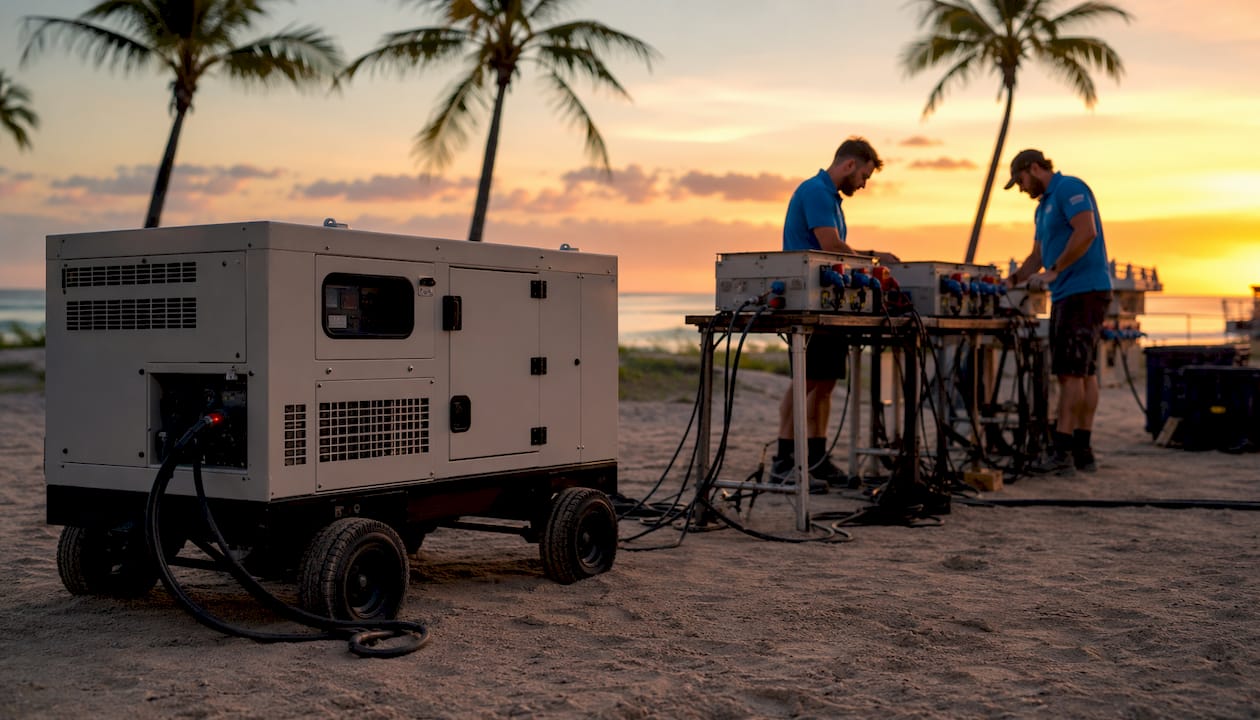
Generators step in where mains is absent or insufficient, particularly for outdoor festivals and rural venues. Silent diesel variants (often called inverter generators at smaller scales) are the standard for events near residential areas. The HSE notes that entertainers with large equipment often need more power than is locally available, making mobile generation a practical necessity rather than a luxury.
Special effects and AV — CO2 cannons, smoke machines, hazers, and LED video walls — are frequently underestimated. A single large LED wall can draw several kilowatts depending on pixel pitch and brightness settings. Plan these as a dedicated zone, not an afterthought plugged into the lighting board.
Charging and UPS cover guest charging points, production laptops, and any system where a sudden power cut would cause real problems (PA amplifiers mid-set, for instance). A small UPS or portable power station handles brief interruptions cleanly for low-draw critical kit.
How do you calculate the load for an event?
The formula is straightforward: Amps = Watts ÷ 230V, and the practical planning rule is 1 kW ≈ 4.3–4.5A. Work through it in steps:
- List every piece of equipment and its rated wattage (check the nameplate or spec sheet).
- Use steady-state watt values, not peak figures.
- Add 20–25% headroom for inrush and surge currents — motors and amplifiers draw significantly more at start-up than at steady state.
- Apply diversity where appropriate: not everything runs at full load simultaneously.
- Convert the adjusted total to amps and match to your supply or generator rating.
| Equipment | Typical load (kW) | Approximate amps (230V) | Phase note |
|---|---|---|---|
| DJ rig | 1.0–1.5 kW | 4–6.5 A | Single-phase |
| Full band PA | 2.0–3.0 kW | 8–13 A | Single or three-phase |
| Catering hot cupboard | 1.5–3.0 kW | 6.5–13 A | Single-phase |
| LED video screen (large) | 3.0–6.0 kW | 13–26 A | Three-phase advisable |
| Lighting rig (full show) | 5.0–15.0 kW | 22–65 A | Three-phase |
Once your site total exceeds a certain kilowattage threshold, a three-phase supply or generator becomes the practical choice. For event power distribution across multiple zones, splitting loads across phases also prevents nuisance tripping.
UK safety regulations and certification you must have
The mandatory references for any UK temporary event installation are: BS 7671 (IET Wiring Regulations), BS 7909:2023+A1:2024, the Electricity at Work Regulations 1989, and HSE guidance including GS50. These are not optional frameworks — they underpin legal compliance and, critically, your event insurance.
BS 7909:2023+A1:2024 sets out design, distribution, protection, and management requirements specifically for temporary entertainment installations. It supplements BS 7671, which remains the baseline for all electrical work in the UK. The Electricity at Work Regulations 1989 place a legal duty on anyone who controls electrical systems to keep them safe.
Documents your contractor must provide:
- Site risk assessment and method statement (RAMS)
- Electrical completion certificate
- Inspection and test results (including RCD operating times)
- PAT records for all portable appliances
- Circuit protection details: type, rating, and discrimination of RCDs and RCBOs
- Commissioning sign-off with the SPR’s signature
The SPR role, defined in BS 7909, carries real legal weight. The SPR must be competent, must oversee the design and management of the installation, and must sign off before the public are admitted. No SPR, no compliant installation — and potentially no valid insurance cover if something goes wrong.
Pro Tip: Ask for the SPR’s name and evidence of competence (NICEIC, NAPIT, or equivalent registration) before you sign any contract. A contractor who cannot name their SPR at the quotation stage is a red flag.
Distribution boards, connectors, and cabling for events
Temporary event distribution follows a hierarchy: primary distribution board (PDB) from the supply source, secondary distribution boards (SDBs) serving zones, and final socket outlet boards feeding individual loads. Every socket outlet circuit at the final level must carry 30 mA RCBO protection — no exceptions under BS 7671 Regulation 411.3.3.
Essential distribution requirements:
- Portable distribution boards rated and weatherproofed for outdoor use (IP rating appropriate to site exposure)
- 30 mA RCBOs on every final socket circuit; time-delayed upstream RCDs (100–300 mA) for discrimination
- TN-S earthing arrangement; never use PME (TN-C-S) for temporary event supplies without an isolation transformer
- BS EN 60309 (IEC 60309) connectors (Ceeform) for all industrial connections; Powerlock for high-current primary feeds
- Domestic 13A extension leads are not suitable for professional event use
For cabling, use heavy-duty rubber-sheathed flexible cable for outdoor runs. Where cables cross pedestrian routes, use proper cable ramps or covers. Armoured cable is appropriate where mechanical damage risk is high. The role of cabling in event reliability is frequently underestimated — a damaged cable mid-event is not just a nuisance, it is a safety incident.
How to choose and size generators for your event
Never run a generator above roughly 80% of its continuous rating. That headroom absorbs inrush currents and gives you room to add a forgotten load without tripping the machine. Split your site into power zones and assign a generator (or a dedicated distribution feed) to each zone.
| Site load total (kW) | Generator sizing guidance | Phase |
|---|---|---|
| Small loads | Appropriate small kVA rating | Single-phase |
| Medium loads | Medium kVA rating | Single or three-phase |
| Large loads | High kVA rating | Three-phase |
| Very large loads | Multiple units or very high kVA rating | Three-phase |
Operational considerations:
- Fuel logistics: calculate run time at expected load, not rated capacity; plan refuelling windows that do not coincide with peak performance moments
- Noise: silent or super-silent diesel sets are standard near residential areas; check local authority restrictions
- Placement: generators must be positioned away from public access with clear exhaust ventilation, and separated from food preparation areas
- Standby: for critical supplies (PA, emergency lighting), either an automatic changeover unit or a dedicated standby operator is necessary
For private events, the generator hire process involves specifying load, site access, fuel type, and noise limits upfront. Leaving any of those to the day is how events go dark at the wrong moment.
What should you require from a power supplier or contractor?
Checklist before you sign:
- Proof of competence: NICEIC, NAPIT, or equivalent registration
- Public liability and professional indemnity insurance certificates
- Electrical completion certificate and full test results
- Written RAMS specific to your site
- PAT testing records for all portable appliances they supply
- Named SPR and evidence of their competence
- Commissioning sign-off procedure and timing
Contract clauses worth including: scope of supply, standby response times, fuel and refuelling responsibilities, noise limits, testing windows before public admission, and liability for failure to supply.
Pro Tip: Insist on a staged switch-on commissioning test with documented load results before the public arrive. Any contractor who resists this is telling you something important about how they work.
Common mistakes and red flags to watch for
Planning mistakes that cause problems:
- Using domestic extension leads or household consumer units for event loads
- Confusing single-phase and three-phase capacity when ordering supply
- Ignoring inrush currents and ordering a supply with no headroom
- Failing to appoint a named SPR before the installation begins
- Skipping the pre-event commissioning test
Supplier red flags:
- Refusal to provide certificates, test records, or a written RAMS
- No BS EN 60309 connectors in their kit (relying on 13A domestic plugs throughout)
- Undersized cabling for the stated load
- Reluctance to perform on-site testing before the event opens
- Cannot name their SPR or provide registration evidence
On the insurance point: using household-grade equipment for a professional event can invalidate your cover entirely if an electrical incident occurs. Professional installation is not a premium add-on — it is what keeps your policy valid.
Key takeaways
Calculating total load in kilowatts, appointing a competent SPR, and requiring BS 7909:2023+A1:2024-aligned certification from your contractor are the three non-negotiable steps for safe, compliant event power in the UK.
| Point | Details |
|---|---|
| Load calculation first | Use Amps = Watts ÷ 230V and add 20–25% headroom for inrush before specifying supply. |
| Appoint an SPR | The Senior Person Responsible must be named, competent, and sign off before public admission. |
| Require BS 7909 compliance | Insist on completion certificates, test results, and a written RAMS from every contractor. |
| Split into power zones | Distribute loads across zones and generators; never run a generator above ~80% continuous rating. |
| Jakspartypower for Sussex events | Jakspartypower provides generator hire, distribution boards, cabling, and on-site standby with extensive electrical contracting experience. |
Why the paperwork matters more than the kit
Most event power failures are not equipment failures. They are planning failures: a load calculation done on the back of an envelope, an SPR appointed in name only, a commissioning test skipped because the band arrived late. The kit is almost always fine. The process around it is where things go wrong.
The compliance framework — BS 7671, BS 7909, the Electricity at Work Regulations 1989 — exists precisely because temporary installations carry risks that permanent ones do not: mechanical stress on cables, public access, weather exposure, and the pressure of a live event where no one wants to stop and investigate a tripped breaker. A contractor who treats the paperwork as bureaucracy rather than risk management is one whose installation you should not be energising.
There is also a practical argument beyond safety. An electrical incident at an event, even a minor one, triggers insurance scrutiny. The first question is always whether the installation was compliant and documented. Certificates and test records are your answer to that question. Without them, you are exposed.
Jakspartypower: event power for Sussex and beyond
Forty years of electrical contracting experience is a long time to learn what goes wrong at events. Jakspartypower has spent that time building a service that covers every stage of the power planning process: site survey, load calculation, generator hire, distribution boards, cabling, and on-site standby throughout your event.

The standby service is the part most planners only appreciate after they have needed it. Having a qualified engineer on site during a live event, with the authority and equipment to resolve a distribution fault without stopping the show, is the difference between a minor incident and a cancelled performance. Jakspartypower’s installations comply with BS 7909:2023+A1:2024 and BS 7671, and every job comes with the completion certificates and test records your insurers and venue managers will ask for. To discuss your event’s power requirements or hire a generator for your next event, get in touch with the Jakspartypower team for a site survey and quote.
Useful sources
Every UK event planner working with temporary electrical systems should keep these references to hand:
- BS 7909:2023+A1:2024 — the current code of practice for temporary electrical systems in entertainment; the primary standard for event installations
- BS 7671 (IET Wiring Regulations) — the baseline for all UK electrical work, including temporary installations
- HSE GS50 — Electrical Safety at Places of Entertainment; practical HSE guidance on layout, power, earthing, and cable routing
- Electricity at Work Regulations 1989 — the legal duty holder framework for anyone controlling electrical systems
- IET Wiring Matters — technical guidance on temporary power distribution, cable selection, and competence requirements
Retain copies of all completion certificates, test results, and RAMS in your event documentation file. When verifying contractor competence, check registration directly with NICEIC or NAPIT rather than relying on a contractor’s self-declaration.
FAQ
What is the formula for calculating event power load?
Use Amps = Watts ÷ 230V, with a practical rule of 1 kW ≈ 4.3–4.5A. Always add 20–25% headroom for inrush currents before specifying your supply or generator.
When do you need three-phase power for a party?
Once your total site load climbs above a moderate continuous current, or when individual pieces of equipment (large PA systems, LED screens, full catering lines) require it, three-phase supply becomes the practical and often necessary choice.
What documents should a UK event electrical contractor provide?
At minimum: a written RAMS, electrical completion certificate, inspection and test results, PAT records for portable appliances, and commissioning sign-off from the named SPR, all aligned with BS 7909:2023+A1:2024 and BS 7671.
What is the SPR role under BS 7909?
The Senior Person Responsible is the competent individual legally accountable for the design, management, and sign-off of a temporary event electrical installation. Their sign-off is required before the public are admitted.
Can Jakspartypower supply generators and on-site standby for events?
Yes. Jakspartypower provides generator hire, distribution boards, cabling, and on-site standby support for events in Sussex, with installations compliant with BS 7909:2023+A1:2024 and BS 7671.