
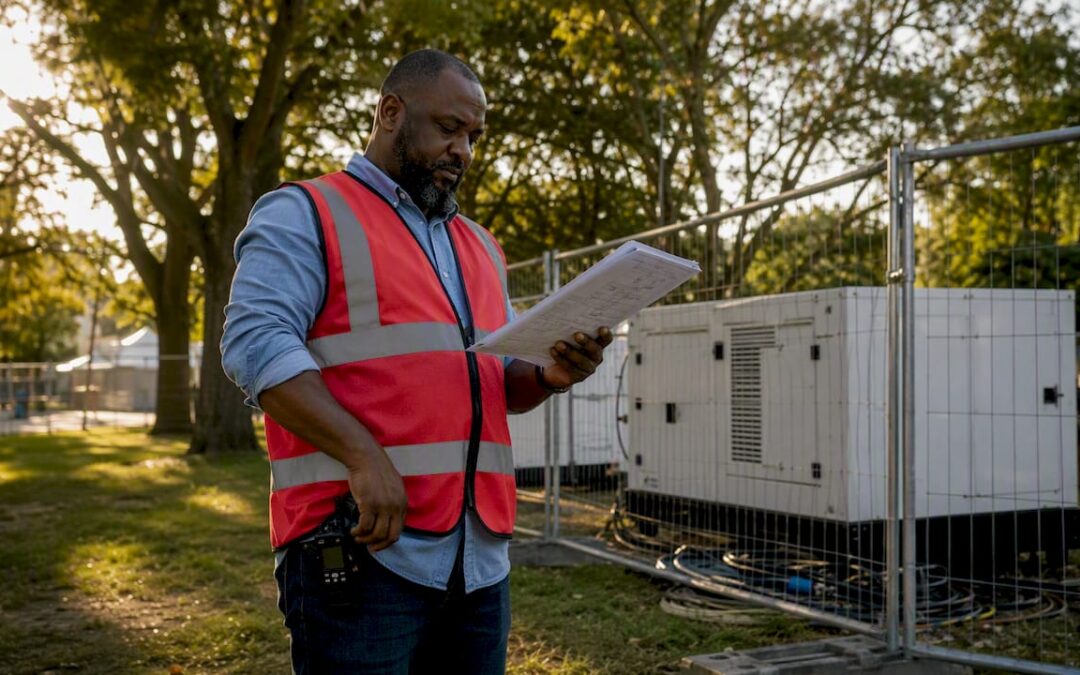
Generators are the primary, reliable on-site power supply and redundancy backbone for lighting, sound, catering and safety-critical systems at large events. Before anything else, take three steps: confirm your total load by collecting exact kW and amperage figures from every supplier; book a generator with significant headroom above that total and never plan to run it above eighty percent of rated output; and secure a BS 7909-compliant plan with a named Senior Person Responsible (SPR).
Start those conversations with:
- Audio/visual lead — PA cluster, FOH desk, broadcast feeds, LED walls
- Caterer — ovens, warmers, fridges, extraction fans
- Venue or landowner — site access, fuel storage permissions, noise conditions
Table of Contents
- How do generators support large events on site?
- What types of generators and fuels work best for UK events?
- How do you size a generator for a large event?
- How should generators be deployed and distributed safely at UK events?
- What maintenance and monitoring keeps power reliable throughout an event?
- When should you book a generator and what drives the cost?
- What should you check before hiring a generator provider?
- Expert recommendations and common planning mistakes
- Key takeaways
- Why early power planning is the decision that matters most
- Jakspartypower: generator hire and standby support for large events
- FAQ
- Useful UK sources for event power planning
How do generators support large events on site?
Generators provide continuous, uninterrupted power to every system that makes a large event function. That sounds obvious until the main supply trips at 9 PM during a headline set. The benefits of professional generator hire go well beyond simply having electricity on site.
Primary supply functions cover the systems that run from the moment doors open:
- Stage lighting rigs, moving heads and LED wash systems
- PA clusters, monitor systems and FOH mixing desks
- Broadcast and streaming feeds, including camera power and comms
- Commercial catering: induction hobs, convection ovens, heated display units
- Bar refrigeration, ice machines and draught cooling
Redundancy and failover matter most for the systems where failure causes genuine harm or legal liability. Medical tents, emergency lighting, fire alarm panels and communications infrastructure all need a guaranteed supply that does not depend on a single genset staying healthy. At a festival with 5,000 attendees, a medical tent losing power is not an inconvenience.
Power quality is a separate concern that organisers often overlook. Sensitive audio equipment, digital mixing desks and broadcast encoders are vulnerable to voltage fluctuations and harmonic distortion. A well-specified generator with automatic voltage regulation (AVR) keeps the supply stable; a poorly loaded or overloaded set can introduce noise and dropouts that no amount of EQ will fix.
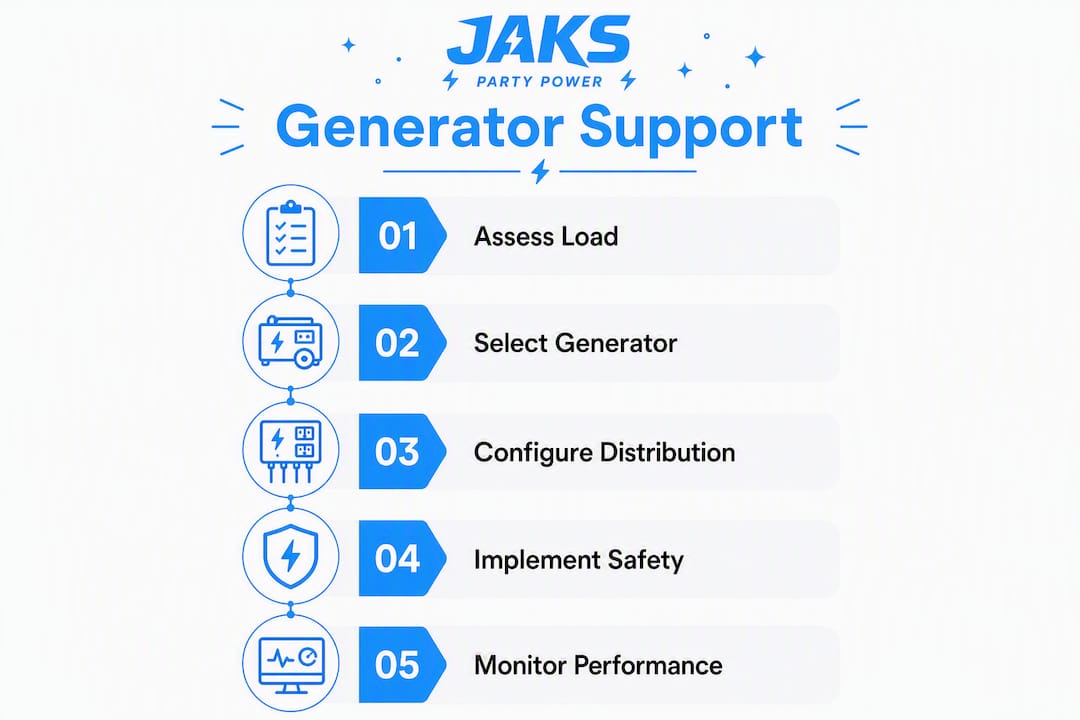
At a corporate gala, a single 100 kVA silent set typically handles lighting, AV and catering from one distribution point. A multi-stage festival needs zoned generation, with dedicated sets for each stage, a separate catering zone and a standby unit on automatic mains failure (AMF). The architecture scales, but the principle stays the same: map the load, match the supply, plan the redundancy.
What types of generators and fuels work best for UK events?
The UK hire market offers several unit types, and the right choice depends on load size, site access, noise conditions and your sustainability commitments.
Road-tow/trailer-mounted diesel sets are the workhorse of the event industry. They range from around 20 kVA to 500 kVA, arrive on a standard trailer, and can be refuelled from a bowser without stopping the event. Availability is excellent across Sussex and the wider South East.
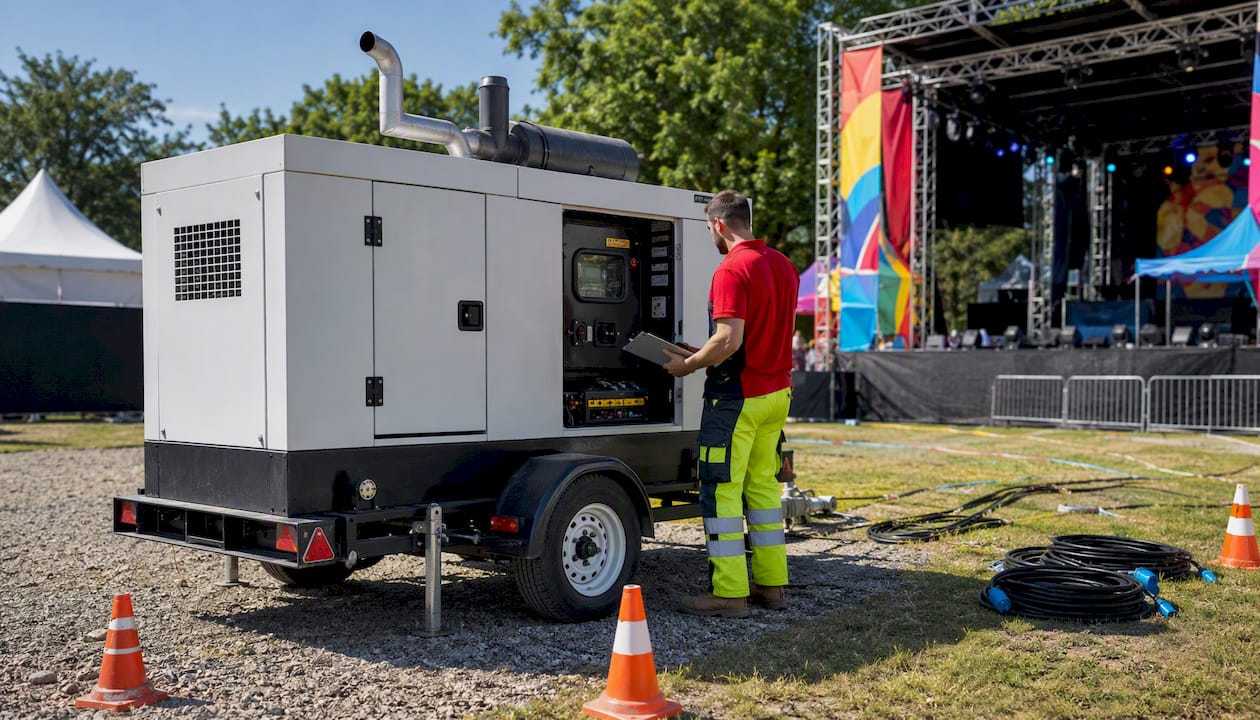
Silent/sound-attenuated sets use acoustic canopies to reduce radiated noise. They cost more to hire but are often non-negotiable at licensed venues, residential-adjacent sites and events with noise conditions attached to their premises licence.
Hybrid sets (battery + generator) allow the genset to run at optimal load while a battery bank handles peaks and troughs. The generator can shut down during low-demand periods, cutting fuel consumption and noise. They are increasingly common at premium festivals and corporate events where sustainability reporting matters.
Trolley/6 kVA units suit low-load applications: a single catering trailer, a small bar, or a temporary welfare cabin. Jakspartypower’s 6 kVA single-phase trolley generator is a practical example for exactly these situations.
Fuel comparison: diesel, HVO, hybrid and battery-supplemented systems
| Fuel/type | Emissions | Noise | Fuel availability (UK) | Runtime | Cost shape |
|---|---|---|---|---|---|
| Standard diesel | Highest | Moderate to high | Excellent | Long | Lowest hire rate |
| HVO (hydrotreated vegetable oil) | Up to 90% lower CO₂ vs diesel | Same as diesel | Growing; not universal | Same as diesel | Small premium on fuel |
| Hybrid (battery + gen) | Lower than diesel | Lowest (gen off at low load) | N/A (gen uses diesel/HVO) | Depends on battery capacity | Higher hire rate |
| Battery-supplemented | Near-zero on site | Silent | N/A | Limited by battery size | High capital cost |
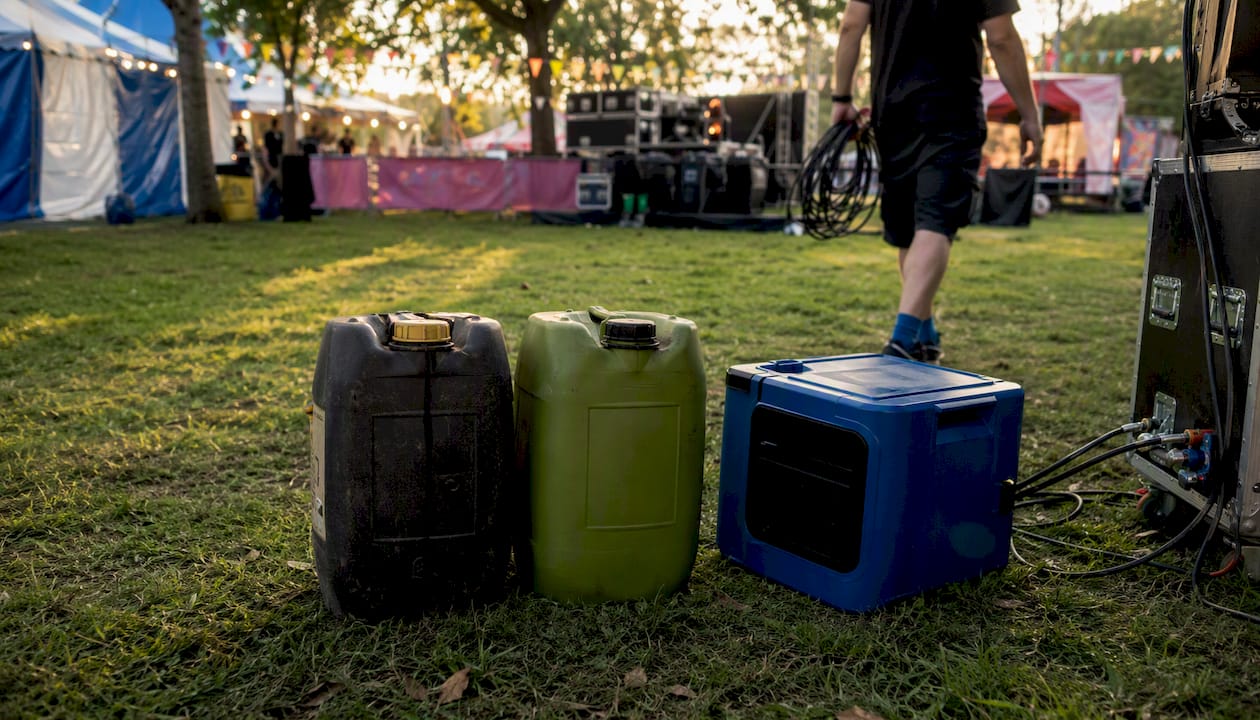
HVO is worth a closer look. It drops straight into any diesel generator with no modification, and the carbon reduction is substantial. Availability from UK fuel suppliers has improved considerably, though you may pay a modest premium per litre compared with red diesel. For events where a local authority or landowner has environmental conditions attached, HVO is often the simplest way to meet them without changing equipment.
On noise: aim for below 65 dB(A) at 7 metres for any boundary-sensitive site. Sound-attenuated canopies, strategic placement behind natural barriers and acoustic baffling panels all help. A generator humming at 72 dB(A) next to a residential fence line will generate complaints before the first act takes the stage.
How do you size a generator for a large event?
Getting the size right is the single most consequential decision in event power planning. Too small and you risk shutdowns; too large and you waste money on fuel and hire costs.
Step-by-step load planning
-
Collect exact figures from every supplier. Ask for manufacturer data sheets showing running watts and start-up (inrush) current. Do not accept estimates. A commercial convection oven that draws 6 kW running may pull 18 kW for two seconds on start-up. That surge has to go somewhere.
-
Build a load schedule grouped into power zones. Stage power, catering, bar, welfare and production each become a zone. Total each zone, then total the zones. This becomes your base load figure.
-
Apply the 80% rule. Generators should not be operated above 80% of rated output to handle unexpected surges and prevent overheating. Divide your base load by 0.8 to find the minimum rated kVA you need.
-
Add 30–50% headroom above that figure to cover simultaneous start-up surges, late additions to the equipment list and any load you have underestimated. A 50 kVA road-tow generator suits a medium corporate event; a large festival stage typically needs 150–250 kVA or more per stage.
-
Model start-up surges for motors and catering equipment. Plan soft-start devices or staggered power-on sequences where multiple large loads start simultaneously. This is particularly relevant for commercial refrigeration banks and large PA amplifier racks.
Sample equipment power reference
| Equipment | Typical running load |
|---|---|
| FOH mixing desk and outboard | 1–3 kW |
| LED moving head rig (24 fixtures) | 6 kW |
| Commercial convection oven | 5–7 kW |
| Heated display/warming unit | 2–4 kW |
| Bar refrigeration (full bar) | 3–6 kW |
| LED stage wash (per 6-unit bar) | 1–2 kW |
| Broadcast/streaming encoder rack | 2–5 kW |
These are representative figures for planning purposes. Always verify against the actual equipment data sheets your suppliers provide. For a detailed breakdown of lighting loads specifically, the Jakspartypower guide on event lighting power consumption is worth reading before you finalise numbers.
Sizing checklist:
- Single-line diagram drafted and agreed with the SPR
- Synchronisation requirement assessed (multiple generators or mains + generator)
- Backup/standby set specified and positioned
- Fuel strategy confirmed: tank size, bowser access route, refuelling schedule
Pro Tip: Ask your audio and lighting suppliers for the figures from the manufacturer’s data sheet, not a rough estimate. The difference between “about 20 amps” and the actual 34-amp inrush on a large amplifier rack is the difference between a stable event and a tripped breaker mid-set.
How should generators be deployed and distributed safely at UK events?
Safe deployment is governed primarily by BS 7909:2023, the code of practice for temporary electrical systems in entertainment, which supplements BS 7671 (the IET Wiring Regulations). Every temporary electrical installation at a public event in the UK should be designed, installed and verified against these standards.
Site placement
- Position generators away from public access areas, with physical barriers and clear signage.
- Allow adequate ventilation and exhaust clearance; never position exhaust outlets towards food preparation areas, welfare tents or audience zones.
- Fuel tanks must be bunded to contain spills; the Environment Agency’s guidance on fuel storage applies even for temporary installations.
- Maintain a minimum separation distance from the public consistent with your risk assessment and the generator manufacturer’s guidance.
Distribution and earthing
Portable distribution boards used at outdoor events are weatherproof and include RCD protection, circuit breakers and load monitoring. Every circuit feeding public-accessible areas needs RCD protection at the appropriate sensitivity. Cable runs must be protected against mechanical damage: cable ramps, overhead runs or armoured cable where ground-level routing is unavoidable.
Earthing arrangements depend on the generator configuration. A standalone generator typically creates a TN-S or IT system; earthing must be documented on the single-line diagram and verified before energising. Where you are interconnecting a generator with a mains supply or running multiple generators in parallel, the earthing strategy becomes significantly more complex and requires a competent designer. The IET’s guidance on temporary electrical systems covers this in detail.
For a practical overview of distribution board selection and installation, the Jakspartypower guide on event power distribution covers the key decisions.
Safety checklist
- SPR appointed and named on all documentation
- Single-line diagram completed and signed off
- All equipment secured against public access; public-accessible equipment locked or guarded
- RCD protection on all circuits
- Cable protection in place across all pedestrian and vehicle routes
- Inspection and test certificate completed before energising
- HSE notification made where required under the Electricity at Work Regulations 1989
What maintenance and monitoring keeps power reliable throughout an event?
Reliable power at a large event is not a set-and-forget proposition. It requires structured checks before, during and after.
Pre-event:
- Load-bank test the generator at the planned operational load to confirm it performs as specified.
- Complete a full service check: oil, coolant, belts, filters and battery condition.
- Run a fuel-top test: fill the tank, run the set for at least 30 minutes under load, check for leaks and confirm fuel consumption rate against your refuelling plan.
- Verify telemetry or remote monitoring is active and sending data to the nominated operator.
During the event:
- Assign a nominated on-site operator or confirm remote telemetry coverage with a callout response time that suits the event scale.
- Schedule refuelling slots during low-activity periods (changeovers, intervals) and document who is responsible. Refuelling plans should cover timing, responsible staff and how to refuel without disrupting live operations, with bunded tanks and spill control in place.
- Monitor load percentage continuously; if a set approaches 80% of rated output, investigate before it becomes a problem.
- Keep a fault log: any trip, voltage anomaly or unusual noise gets recorded with a timestamp.
Standby and AMF arrangements:
An AMF system automatically starts a backup generator if the primary set fails, with changeover times typically under 10 seconds. For medical, emergency lighting and communications circuits, AMF is not optional at large events. The backup set should be sized to handle at least the critical load independently, and tested under load before the event opens.
For further detail on power contingency planning and redundancy configurations, Jakspartypower’s dedicated guide covers the options in practical terms.
Post-event:
- Allow the generator to cool down under light load before shutdown.
- Reconcile fuel used against the refuelling log.
- Complete a defect report for any faults noted during the event.
- Obtain a test sign-off from the SPR confirming the installation was de-energised safely.
When should you book a generator and what drives the cost?
Lead times matter more than most organisers expect, particularly in the summer season when hire stock across Sussex and the South East is heavily committed.
Booking timeline guidance:
- Small events (up to 50 kVA, single set): book 2–4 weeks ahead minimum; 6–8 weeks in peak season (May to September).
- Medium events (50–150 kVA, multiple circuits): allow 4–8 weeks; longer if you need silent sets, which are in shorter supply.
- Large events and festivals (150 kVA+, multiple sets, AMF): plan 3 months or more ahead. Complex multi-generator configurations require design time as well as equipment availability.
Principal cost drivers:
- kVA size: the largest single factor. A 20 kVA set costs a fraction of a 250 kVA silent set.
- Runtime and fuel: longer events consume more fuel; HVO carries a modest premium over standard diesel.
- Noise/silencing: sound-attenuated canopies add cost; factor this in early rather than as a late upgrade.
- Delivery and logistics: distance, access restrictions and crane lifts for confined sites all affect price.
- On-site support: a nominated operator or standby engineer adds to the day rate but is often the most cost-effective insurance you can buy.
- AMF/standby set: a second generator configured for automatic failover roughly doubles the equipment cost but is standard practice for high-profile events.
Where to save without cutting corners: consolidate power zones to reduce the number of distribution boards; choose a single larger set over two smaller ones where the load profile suits it; and book early to avoid last-minute premium pricing on scarce silent stock.
What should you check before hiring a generator provider?
A thorough checklist protects you from underspecified quotes and providers who cannot deliver on the day.
Pre-hire checklist:
- Load schedule completed and shared with the provider
- Single-line diagram requested and agreed
- SPR nominated and named in the contract
- Insurance and certification documents requested (PAT, test certificates, public liability)
- Fuel plan confirmed: tank size, bowser access, refuelling schedule and responsible person
- Noise mitigation measures specified and agreed
- Site access route confirmed for delivery vehicle and fuel bowser
Questions to ask every provider:
- Can you supply BS 7909-compliant documentation and a named SPR?
- What is your refuelling strategy and who is the responsible person on site?
- Do you provide telemetry monitoring and what is your 24/7 callout response time?
- What is your contingency if the primary set fails?
- Is the quoted set load-bank tested before delivery?
- What earthing arrangement does the set create and how is it documented?
Pro Tip: Watch for quotes that specify kVA without mentioning the 80% operational ceiling, or that omit fuel and delivery from the headline price. A quote that looks 20% cheaper often becomes the same price or more expensive once fuel, delivery and a standby callout are added. Ask for a fully itemised quote before comparing.
Expert recommendations and common planning mistakes
The most consistent finding from experienced event power practitioners is straightforward: involve the power provider before finalising the site plan, not after. Once cable routes, catering positions and stage locations are fixed, retrofitting a sensible power distribution layout becomes expensive and sometimes impossible.
High-impact recommendations:
- Insist on a complete load list from every contractor before the power provider designs the system. A caterer who adds a second oven two weeks before the event can invalidate the entire load calculation.
- Appoint the SPR at the start of the planning process, not as a box-ticking exercise at the end. The SPR’s role under BS 7909 covers design sign-off, installation verification and completion certificates.
- Plan for redundancy from the outset. A single generator serving a 2,000-person event with no backup is a risk that no amount of monitoring can fully mitigate.
- Treat the public as untrained users. Event sites differ from construction sites; any equipment accessible to audiences, including children, must be physically secured and guarded.
Common mistakes that cause real problems:
- Late supplier liaison: the caterer’s load figures arrive the week before the event, too late to upsize the generator.
- Underestimating start-up surges: a bank of commercial refrigeration units starting simultaneously can trip a correctly sized set if inrush current is not modelled.
- Running gensets above 80% of rated output: the set overheats, the protection trips, and the event goes dark.
- Poor cable protection: a cable ramp omitted from a pedestrian route becomes a trip hazard and a potential fault point.
- Allowing public access to generator enclosures: a generator left unlocked in a public area is both a safety failure and a compliance breach under BS 7909.
Jakspartypower brings over 40 years of electrical contracting experience to every event power project, from small private functions to large public shows across Sussex. That depth of experience means the common mistakes above are caught at the planning stage, not discovered during the event.
Pro Tip: Ask your power provider to walk you through the single-line diagram before the event. If they cannot explain it clearly, that is a red flag about the quality of the design behind it.
Key takeaways
Generators are the non-negotiable power backbone of large events: size them to 80% of rated output, appoint an SPR under BS 7909, and book at least 3 months ahead for festival-scale requirements.
| Point | Details |
|---|---|
| Size with headroom | Never plan above 80% of rated output; add 30–50% headroom above your base load total. |
| Appoint an SPR early | BS 7909 requires a named Senior Person Responsible for design sign-off and completion certificates. |
| Book ahead | Small events need 2–4 weeks; large festivals need 3+ months, especially for silent or AMF-configured sets. |
| Plan noise and fuel | Target below 65 dB(A) at 7 m for sensitive sites; confirm fuel type (HVO or diesel) and a documented refuelling plan before the event. |
| Use Jakspartypower | Jakspartypower provides generator hire, distribution, cabling and on-site standby support for large events across Sussex, backed by 40+ years of electrical contracting experience. |
Why early power planning is the decision that matters most
The conventional wisdom in event production is that power is a logistics problem: order the generator, plug things in, done. That framing is wrong, and it is the reason so many events encounter power failures that were entirely avoidable.
Power planning is a design problem. The load list, the single-line diagram, the earthing strategy, the refuelling schedule, the AMF configuration: these are design decisions that interact with each other and with every other element of the site plan. Change the catering layout and you change the cable routes. Add a second stage and you change the generation architecture. Do it late and you are retrofitting, which costs more and delivers less.
The 80% operational ceiling is a good example of a rule that sounds simple but has real consequences when ignored. A generator running at 95% of rated output on a warm August afternoon, with a surge load from a bank of refrigeration units starting simultaneously, will trip. The protection system does exactly what it is designed to do. The event goes dark. The crowd does not care about the technical explanation.
What actually works is treating the power provider as a design partner from the moment the site plan is first sketched. Share the load list early, even if it is incomplete. Revisit it as suppliers confirm their equipment. Build the redundancy in from the start rather than adding a backup set as an afterthought. And appoint the SPR before anyone starts specifying cable sizes.
The events that run without a power incident are not the ones with the most expensive equipment. They are the ones where someone asked the right questions in the right order, early enough to act on the answers.
Jakspartypower: generator hire and standby support for large events
For event planners who need reliable power across Sussex, Jakspartypower offers something most hire companies do not: a complete, single-source solution that covers generator hire, distribution boards, cabling, fuel management and on-site standby support, all backed by over 40 years of electrical contracting experience.
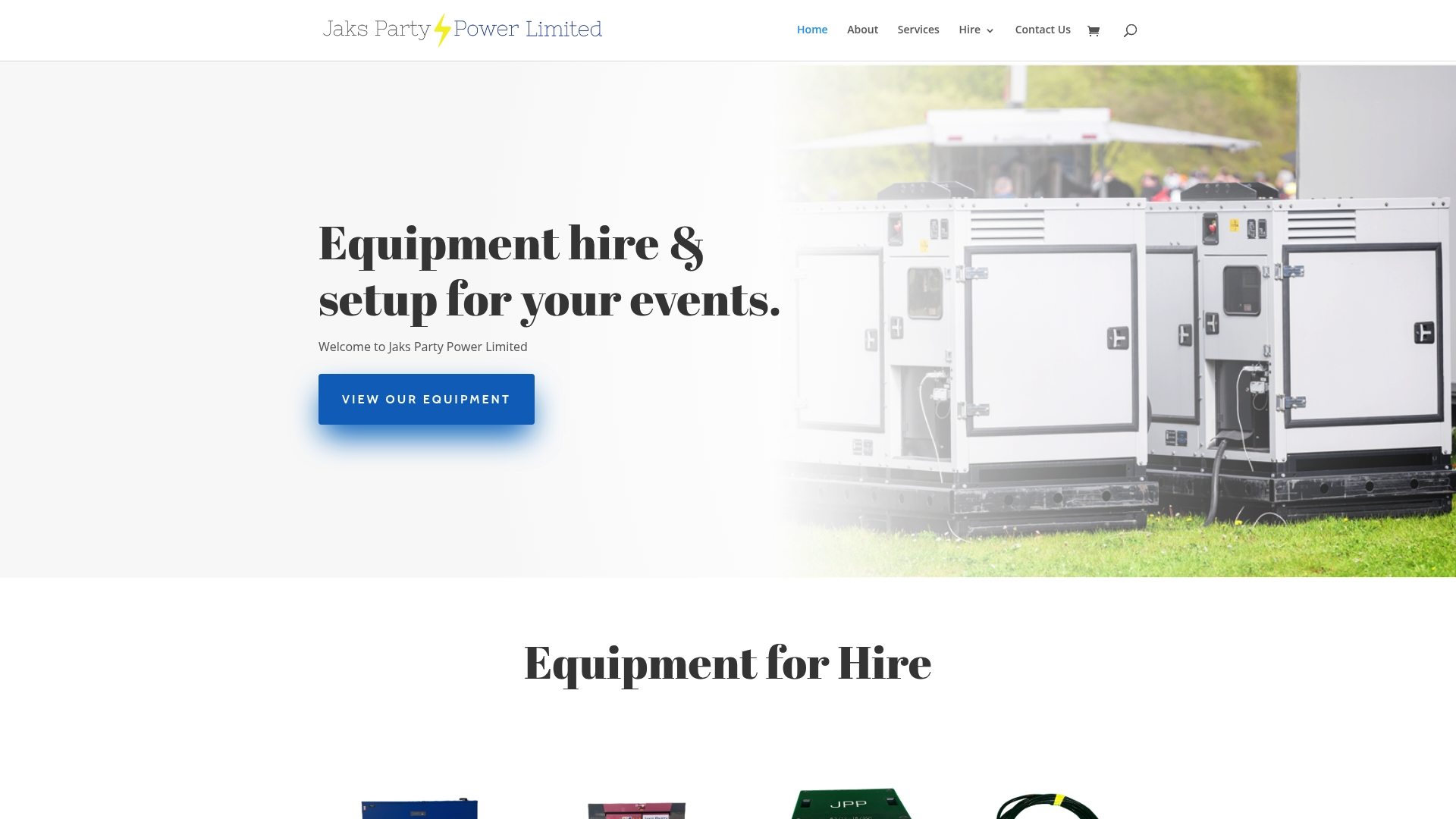
The standby service is the part that matters most on the day. Having a qualified technician on site, monitoring load and fuel in real time, means problems are caught before they become failures. That is a different proposition from hiring a generator and hoping it runs. Jakspartypower’s team can supply BS 7909-capable documentation, nominate an SPR, and manage the full temporary electrical installation from design through to de-energisation.
Whether you are planning a corporate gala, a large outdoor show or a multi-day festival, get in touch via the Jakspartypower website to discuss your load requirements and get a fully itemised quote. If you are ready to look at specific equipment, the generator hire page lists available sets with specifications. For a complete picture of what to ask for and what to expect, the event equipment hire checklist is a practical starting point before your first conversation.
FAQ
What is the role of a generator at a large event?
A generator provides the primary on-site power supply for lighting, sound, catering and safety-critical systems, and acts as the redundancy source when mains power is unavailable or unreliable. At large events, generators are typically the sole power source for all production systems.
What size generator do I need for an event?
Calculate your total running load from supplier data sheets, divide by 0.8 to apply the 80% operational ceiling, then add 30–50% headroom for surges and late additions. A medium corporate event typically needs around a 50 kVA generator; a large festival stage commonly requires 150–250 kVA or more per stage, depending on production requirements.
What is BS 7909 and why does it matter for event power?
BS 7909:2023 is the UK code of practice for temporary electrical systems in entertainment. It requires the appointment of a Senior Person Responsible (SPR) and sets out design, installation and documentation standards for all temporary event power installations.
What is the 80% rule for generators?
Generators should not be operated above 80% of their rated output. Running above this ceiling reduces the headroom needed to absorb start-up surges and risks overheating and automatic shutdown, which cuts power to the entire event.
Can HVO fuel be used in standard diesel generators?
Yes. HVO (hydrotreated vegetable oil) is a drop-in replacement for diesel in standard generators with no modification required. It can reduce CO₂ emissions by up to 90% compared with standard diesel, making it a practical option for events with environmental conditions or sustainability reporting requirements.
Useful UK sources for event power planning
The standards and guidance below are the primary references for any event power installation in the UK. Consulting them directly, rather than relying solely on hire company summaries, is the mark of a well-prepared organiser.
- BS 7909:2023 (BSI): — The definitive code of practice for temporary electrical systems in entertainment. Consult it for SPR responsibilities, design requirements, inspection and test documentation, and earthing arrangements.
- BS 7909 and electrical safety at events (Richmond Council/HSE): A practical summary of how BS 7909 applies to public events, covering the legal framework under the Electricity at Work Regulations 1989 and Health and Safety at Work Act 1974.
- IET Guide to Temporary Electrical Systems, 2nd Edition: — Covers generator selection, cable sizing, hybrid system deployment and design methodology. Useful for any planner working with a power designer on a complex multi-source installation.
- BBC Safety: Temporary Electrical Systems and BS 7909: Practical competence guidance for those working with temporary electrical systems, including generators and distribution.
- Jakspartypower: event power planning stages: A step-by-step UK planning guide covering coordination, load scheduling and documentation from first enquiry to post-event sign-off.
- Jakspartypower: what is event power risk management: Covers risk assessment frameworks and safety protocols for temporary power installations at public events.
Statistic to note: HVO can reduce CO₂ emissions by up to 90% compared with standard diesel, making it the most accessible lower-carbon fuel option for events using standard diesel generator sets.