
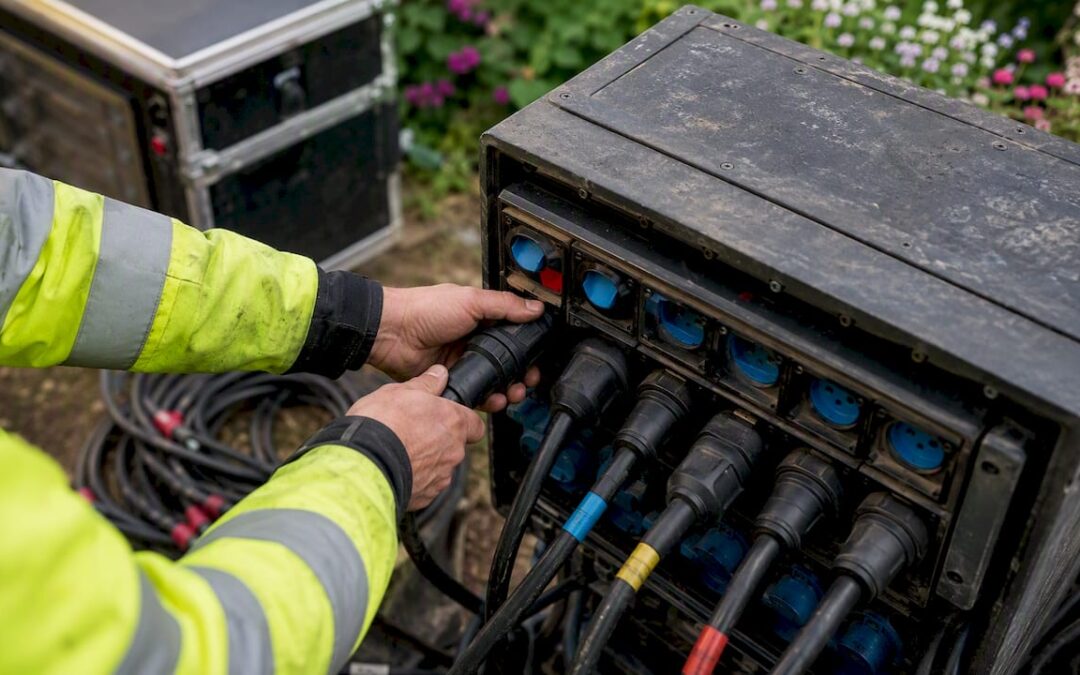
Five HSE-aligned venue distribution setups cover the most common event types planners encounter in the UK:
- Small meeting/networking (up to 20 A single-phase mains): One consumer-unit sub-board, BS 1363 13 A sockets, a 30 mA RCD protecting all portable equipment circuits. Equipment: small distribution board, RCD adaptor, PAT-tested extension leads. Jakspartypower can supply and test the board.
- Club night/DJ set (single-phase, 60–100 A): Split circuits for DJ rig and bar, BS EN 60309 16 A blue outlets for DJ and catering, 30 mA RCDs per circuit group.
- Theatre/blackbox (single- or three-phase, 100–200 A): Dimmer rack on a dedicated circuit, signal multicore routed separately from power, phase allocation logged.
- Outdoor festival stage (400 V three-phase, 125 A+): Generator feed with separate TT earthing, 125 A three-phase main distro, sub-distributions to lighting, PA and catering.
- Corporate gala with standby generator (mains primary + generator standby): Automatic changeover panel, labelled sub-distributions, standby technician on site.
Key takeaways
Matching the right distribution setup to your event size, and testing it before doors open, is the single most effective way to prevent power failures and pass a local authority inspection.
| Point | Details |
|---|---|
| Match setup to event size | Use single-phase sub-boards for small events; 125 A three-phase distros for festivals and large galas. |
| Limit circuits per RCD | Industry guidance suggests no more than six final circuits behind one 30 mA RCD to localise faults. |
| Test generator earthing | Earth resistance must be tested and recorded before the event opens, per HSE GS50. |
| Keep commissioning records on site | RCD test log, earth-resistance certificate, PAT records and SPR handover note must be accessible during the event. |
| Jakspartypower for hire and standby | Jakspartypower supplies generators, distribution boards up to 125 A three-phase, and on-site standby technicians across Sussex. |
Table of Contents
- Examples of venue distribution setups by event type and size
- UK components, socket types and regulations you must follow
- How to size loads, group circuits and balance phases
- Redundancy models and contingency planning for power failures
- Practical cable routing, connector choices and site layout
- Pre-event commissioning and safety checklist
- Single-line descriptions you can hand to an electrician
- When to hire a specialist and what Jakspartypower provides
- Why these examples and UK compliance matter
- Jakspartypower: power hire and standby support for UK events
- Sources
- FAQ
Examples of venue distribution setups by event type and size
Small meeting or networking event
A single-phase supply from the venue’s existing consumer unit usually covers events up to around 20 A. The distribution board sits near the main supply point, feeding BS 1363 13 A sockets via a 30 mA RCD. Keep the board labelled and locked if it is accessible to guests.
Equipment list: small 6-way distribution board, RCD-protected extension leads, PAT-tested adaptors.
- Risk note: verify the venue’s existing supply capacity before adding load; a networking event electrical setup guide covers the checklist in detail.
Pro Tip: Label every circuit at the board with its load (e.g. “AV desk — 5 A”) so any fault can be isolated in seconds without guessing.
Club night or DJ set
Split the single-phase supply into at least two circuit groups: one for the DJ rig and one for bar equipment. Use BS EN 60309 16 A blue outlets (IEC 309) for the DJ desk and any catering equipment drawing above 13 A. Each group gets its own 30 mA RCD.
Equipment list: 63 A single-phase distro, 16 A BS EN 60309 outlets, 13 A BS 1363 sockets for ancillaries, RCD-protected multiway.
- Risk note: bar fridges and coffee machines cause nuisance tripping if grouped with audio; keep them on a separate RCD group.
Pro Tip: Place the RCD at the sub-distribution board, not buried behind the DJ booth, so the duty electrician can reset it without disturbing the performance.
Theatre or blackbox venue
Three-phase supply (or a large single-phase) feeds a dimmer rack on its own dedicated circuit, separate from the PA and any practical lighting. Route signal multicore at least 300 mm away from power cables, or use screened cable where separation is impossible. Allocate heavy dimmers to one phase and PA to another to avoid single-phase overloads. See party entertainment power needs for performer-specific load guidance.
Equipment list: 125 A three-phase distro, dimmer rack (dedicated 32 A circuit per rack), signal multicore, 16 A and 32 A BS EN 60309 outlets.
- Risk note: dimmer racks generate harmonic currents; check neutral conductor sizing with your electrician.
Outdoor festival stage
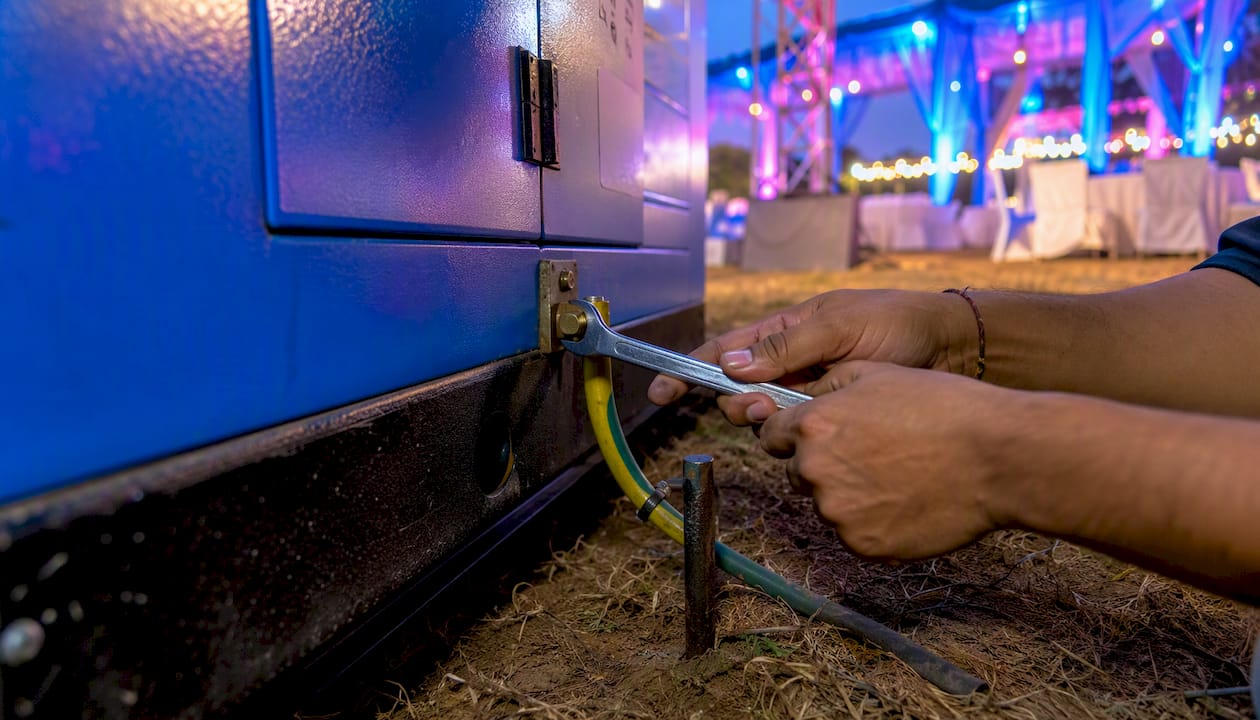
This is where distribution design earns its keep. A 125 A three-phase generator feed (or temporary DNO supply) connects to a main distro with a 125 A isolator. Sub-distributions branch to lighting, PA, catering and crew welfare separately. Generator earthing must be tested and recorded before the event opens, per HSE GS50.
Equipment list: 125 A three-phase main distro, 63 A sub-distros (lighting, PA, catering), 32 A and 16 A BS EN 60309 outlets, cable ramps, earth spike and test equipment.
- Risk note: generators must not be paralleled with public supply without written DNO agreement.
Pro Tip: Fit a weatherproof cover to every outdoor distribution board and padlock it. Public access to live distribution equipment is a serious liability.
Corporate gala with standby generator
Primary mains supply feeds the main distro; a standby generator connects via an automatic changeover panel (ATS). Sub-distributions are labelled by zone: catering, AV, lighting, guest areas. A standby technician monitors the system throughout. This is the setup where a standby service for corporate events pays for itself.
Equipment list: ATS panel, 125 A three-phase main distro, zone sub-distributions, standby generator, labelled single-line diagram.
- Risk note: test the ATS changeover under load before guests arrive.
UK components, socket types and regulations you must follow
The HSE GS50 guidance is the practical starting point for any temporary event electrical installation. It specifies 30 mA RCD protection for all sockets used with portable equipment and recommends BS EN 60309 industrial outlets for higher-power needs.
Socket and connector types:
- BS 1363 (13 A): standard UK domestic socket; suitable for low-power ancillaries and office-style equipment indoors.
- BS EN 60309 / IEC 309 (16 A blue): single-phase industrial outlet; DJ rigs, catering, small lighting.
- BS EN 60309 (32 A blue): single-phase; dimmer racks, follow spots, larger catering.
- BS EN 60309 (63 A and 125 A red): three-phase; main stage feeds, large generator outputs.
Regulatory references every planner should know:
- HSE GS50: practical guidance on electrical safety at entertainment venues; covers RCDs, socket types and generator earthing.
- BS 7909:2023: code of practice for temporary electrical systems at entertainment events; sets out the Senior Person Responsible (SPR) duty and single-line diagram requirements.
- BS 7909:2023+A1:2024: the current revised edition, used to evidence compliance with BS 7671 for insurers and local authorities.
- BS 7671: the IET Wiring Regulations; BS 7909 links directly to it for testing intervals and wiring standards.
- Electricity at Work Regulations 1989: the legal duty-holder framework; requires that electrical systems are constructed, maintained and used safely.
RCD requirement: GS50 recommends 30 mA RCD protection for every socket circuit used with portable equipment, with RCDs located at accessible sub-circuit distribution boards.
Must-have components for any temporary distribution:
- Correctly rated main isolator
- 30 mA RCDs at sub-circuit level
- Labelled distribution boards (circuit ID, rating, load)
- BS EN 60309 outlets for any load above 13 A
- Earth continuity and earth-resistance test equipment
How to size loads, group circuits and balance phases
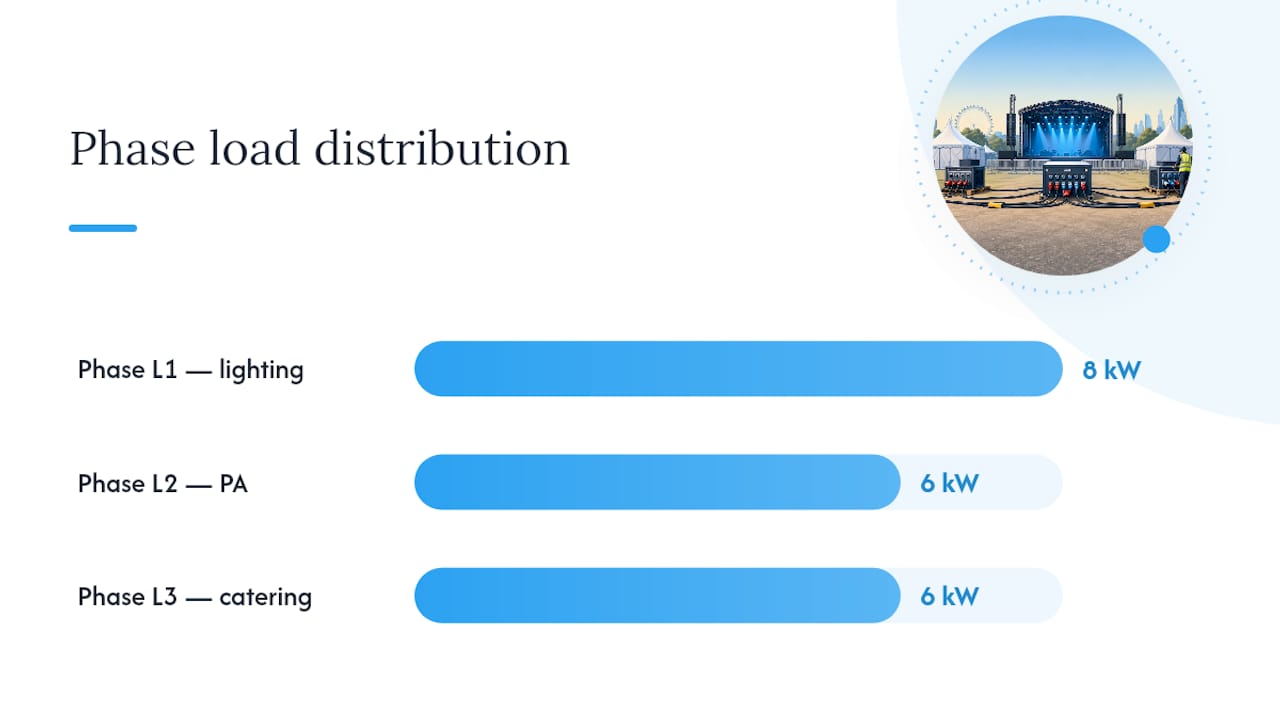
Start with the total connected load per zone, add a 20% headroom margin, then divide across phases so no single phase carries more than the others by more than roughly 10%. For a typical festival stage with a 24 kW lighting rig and a 12 kW PA:
- Phase L1: lighting dimmer rack — 24 kW ÷ 3 phases = 8 kW per phase (three-phase dimmer rack balances automatically).
- Phase L2: PA system — 12 kW ÷ 2 amplifier racks = 6 kW per rack; split racks across L2 and L3.
- Phase L3: catering — 6 kW.
That gives roughly 8 kW, 6 kW and 6 kW per phase: well balanced. Check event lighting power consumption for detailed load figures by fixture type.
Industry guidance suggests keeping no more than six final circuits behind a single 30 mA RCD. More than that and a single fault trips too large a portion of the event.
Pro Tip: Allocate dimmer racks and heavy discharge lighting to their own dedicated circuits, never shared with audio. Dimmers generate voltage spikes that can corrupt digital audio equipment on the same circuit.
Redundancy models and contingency planning for power failures
- Small indoor events: a local UPS for critical AV equipment and a dual-supply arrangement from two separate venue circuits covers most failure scenarios.
- Medium events (club nights, corporate dinners): a small standby generator on a manual changeover switch, tested before the event.
- Large events and festivals: N+1 generator sets with an automatic changeover panel (ATS); separate RCD groups for each distribution zone so a fault in catering does not kill the stage.
HSE GS50 is clear: generators must have their own earthing arrangement and must not be paralleled with public supply without written agreement from the electricity supplier. Earth resistance must be tested and recorded before the event opens. For a festival with multiple gensets, each generator gets its own earth spike, tested independently.
See power contingency planning for a full framework.
Pro Tip: Run a full load test on the standby generator during the technical rehearsal, not the morning of the event. You want to find the fault when there is still time to fix it.
Practical cable routing, connector choices and site layout
Route heavy power cables (63 A and above) away from public walkways wherever possible. Where crossing is unavoidable, use cable ramps rated for the expected foot traffic, or trench and cover with steel plate. Keep signal multicore at least 300 mm from power runs, or use a screened multicore where separation is not achievable.
Connector and cable checklist:
- Use BS EN 60309 connectors for all stage and outdoor feeds above 13 A.
- Colour-code cables by phase (brown L1, black L2, grey L3) and label both ends.
- Secure distribution boards to a fixed structure; never leave them freestanding where the public can reach them.
- Use IP44-rated or higher enclosures outdoors.
- Mark all cable routes on the site plan and include them in the single-line diagram.
Distribution board installation guidance covers fixing, labelling and access control in detail.
Pro Tip: At crossing points, lay power cables first, then run signal cables over the top at 90 degrees. That geometry minimises inductive coupling and keeps the crossing point obvious to anyone working on site.
Pre-event commissioning and safety checklist
Before doors open, work through this checklist and keep the records on site:
- RCD test: press the test button on every RCD; confirm trip time is within limits. Repeat at the start of each event day. BS 7671 and GS50 both support periodic testing; monthly testing is common practice for hire equipment.
- Earth resistance test: for every generator, measure and record earth resistance. GS50 requires this to be documented.
- PAT: all portable appliances brought to site should carry a current PAT label or be tested on arrival.
- Visual inspection: check all connectors are fully engaged, cables are undamaged, distribution boards are labelled and secured.
- Single-line diagram: confirm the installed system matches the diagram before energising.
- SPR sign-off: the Senior Person Responsible (required under BS 7909:2023) signs the handover note.
Records to keep: RCD test log, earth-resistance test certificate, PAT records, single-line diagram, SPR handover note. Keep copies accessible during the event, not locked in a van.
For a full inspection framework, see event electrical equipment inspection.
Pro Tip: Photograph the distribution board labelling and the RCD test results on your phone before the event opens. If a local authority officer asks for records mid-event, you can show them immediately.
Single-line descriptions you can hand to an electrician
A clear single-line diagram is the fastest way to communicate supply, earthing and distribution arrangements to contractors and the local authority safety officer. These text versions are starting points; your electrician will refine them.
Example 1 — Small indoor event:
Supply: 63 A single-phase mains → Main distro (63 A isolator, 30 mA RCD) → 6 × 13 A BS 1363 circuits (AV, lighting, catering × 2, general × 2). Earth: TN-S from venue. All circuits RCD protected.
Example 2 — Club night:
Supply: 100 A single-phase mains → Main distro (100 A isolator) → Sub 1: 32 A (DJ rig, 16 A BS EN 60309, 30 mA RCD); Sub 2: 32 A (bar, 16 A BS EN 60309, 30 mA RCD); Sub 3: 16 A (general, 13 A sockets, 30 mA RCD). Earth: TN-S.
Example 3 — Theatre/blackbox:
Supply: 125 A three-phase DNO → Main distro (125 A isolator) → L1: 63 A dimmer rack (32 A BS EN 60309 outlets); L2: 32 A PA (16 A BS EN 60309); L3: 16 A practicals + general (13 A BS 1363). Signal multicore routed separately. Earth: TN-S. All final circuits 30 mA RCD protected.
Example 4 — Outdoor festival stage:
Supply: 125 A three-phase generator (TT earthing, earth spike tested) → Main distro (125 A isolator, 30 mA RCDs per sub) → Sub A: 63 A lighting distro; Sub B: 63 A PA distro; Sub C: 32 A catering; Sub D: 16 A crew welfare. Earth resistance recorded pre-event.
Example 5 — Corporate gala with standby:
Supply: 125 A three-phase mains → ATS panel → Main distro → Zone sub-distributions: AV (32 A), lighting (63 A), catering (32 A), guest areas (16 A). Standby: 125 A three-phase generator (separate TT earth). All zones labelled, RCD protected, SPR appointed.
Pro Tip: Add conductor colour and phase numbering to every line of the single-line (e.g. “L1 brown, L2 black, L3 grey, N blue, PE green/yellow”). It takes two minutes and saves hours of fault-finding on a dark stage.
When to hire a specialist and what Jakspartypower provides
Hire a specialist contractor when the setup involves any of the following:
- Three-phase distribution (63 A and above)
- Generator installation with earthing tests
- Parallel generator arrangements or ATS panels
- Festival grids with multiple supply points
- Official handover documentation for a local authority or insurer
A competent hire company should provide: generator hire and installation, 125 A three-phase distribution boards, sub-distributions, earthing tests and records, PAT testing, labelled single-line diagrams, on-site standby technicians and a named SPR for handover.
Jakspartypower offers all of these services across Sussex, drawing on over 40 years of electrical contracting experience. Relevant service pages: generator hire, standby service for corporate events, and the event equipment hire checklist.
When requesting a quote, ask for: public liability and employers’ liability insurance certificates, test records from previous comparable events, confirmation of SPR appointment, and a sample single-line diagram.
Why these examples and UK compliance matter
The five setups in this article are not theoretical. They reflect the real range of events where temporary electrical installations go wrong: an undersized sub-board at a networking event, a generator earthed to nothing at a festival, a dimmer rack sharing a circuit with a digital mixing desk. Each failure is preventable with the right design and the right documentation.
BS 7909:2023+A1:2024 and BS 7909:2023 exist because the entertainment industry has a poor historical record on temporary power. Insurers and local authorities now routinely request compliance evidence before issuing licences. The single-line diagram and the SPR handover note are not bureaucracy; they are the two documents that prove someone competent was in charge.
Pro Tip: Appoint your Senior Person Responsible before the design stage, not the day before the event. The SPR needs to review the single-line diagram, agree the earthing strategy and sign off the commissioning checklist. That cannot happen in an hour.
Jakspartypower: power hire and standby support for UK events
Forty years of electrical contracting experience means Jakspartypower has seen every version of these setups, from a single-phase board at a village fête to a 400 V festival grid with N+1 generators. The practical difference is a team that arrives with tested equipment, a single-line diagram already drafted, and a standby technician who stays until the last guest leaves.

Services available for hire and on-site support include generators (single-phase and three-phase), distribution boards up to 125 A three-phase, cable hire, RCD and PAT testing, and a named SPR for handover documentation. Every hire comes with labelled equipment and a commissioning record you can hand to your venue or local authority on the day.
Get in touch via Jakspartypower to discuss your event, or review the professional setup guide to see what a fully compliant installation looks like in practice.
Sources
The following authoritative sources underpin the guidance in this article. BS 7909 is the code of practice used to evidence compliance with BS 7671 for insurers and local authorities.
- Electrical safety at places of entertainment Guidance Note GS50 (Fourth edition) GS50
- BS 7909:2023 – Temporary electrical systems for entertainment and related purposes – Code of practice | BSI Knowledge
- BS 7909:2023+A1:2024 | Temporary electrical systems for entertainment and related purposes – Code of practice | BSI Knowledge
- Temporary Installations BS 7909 | Events & Construction | Elec-Mate
FAQ
What is the minimum RCD protection required for event sockets?
HSE GS50 requires 30 mA RCD protection for all sockets used with portable equipment at entertainment venues. RCDs should be located at accessible sub-circuit distribution boards, not buried inside locked enclosures.
Can a generator run in parallel with the mains supply?
No, not without written agreement from the electricity supplier (DNO). HSE GS50 is explicit on this point. Generators must also have their own independent earthing arrangement, tested and recorded before the event.
What does a Senior Person Responsible do?
Under BS 7909:2023, the SPR is the named individual accountable for the design, installation, testing and handover of the temporary electrical system. They sign the handover note that confirms the installation is safe to energise.
Which connector type should I use for a DJ rig or stage feed?
BS EN 60309 (IEC 309) 16 A blue outlets for single-phase feeds up to 16 A, or 32 A blue for higher-draw equipment such as dimmer racks. BS 1363 13 A sockets are only suitable for low-power ancillaries indoors.
When do I need a specialist electrical contractor for an event?
Any event involving three-phase distribution, generator installation, ATS panels, or official handover documentation for a local authority requires a specialist contractor. Jakspartypower provides all of these services, including on-site standby technicians and SPR appointment, across Sussex.