
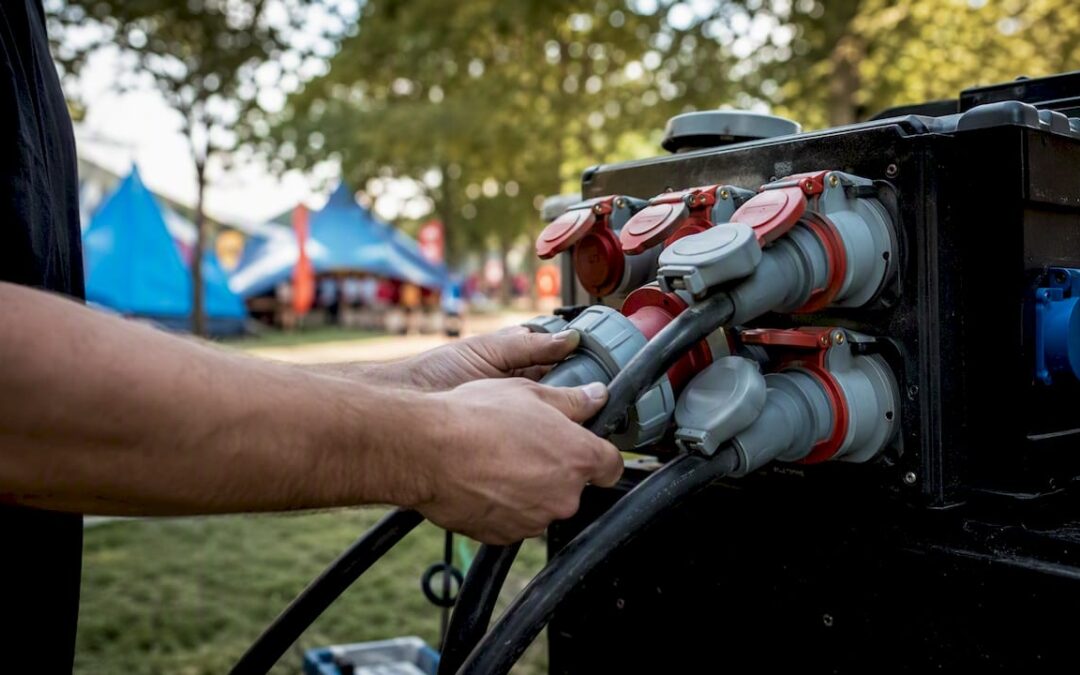
Stage power distribution is the process of taking an incoming electrical supply, whether from venue mains or a temporary generator, and breaking it down into protected, labelled circuits that safely deliver power to lighting rigs, sound systems, stage effects and venue services. Get it wrong and you risk tripped circuits mid-show, equipment damage, or worse. Get it right and nobody in the audience notices the electrical system exists.
Three things to do before anything else:
- Calculate your total kW demand across every load: lighting, audio, backline, catering, comms and production offices.
- Decide your supply type: venue mains (confirm available capacity and earthing arrangement with the venue) or an independent generator supply.
- Appoint a competent electrical contractor who works to BS 7909:2023 and can supply commissioning records before the event goes live.
Key takeaways
Safe, compliant stage power distribution requires a calculated load schedule, purpose-built distribution equipment, 30 mA RCD protection on all final circuits, and a signed commissioning record before any circuit goes live.
| Point | Details |
|---|---|
| Calculate load before specifying supply | Sum all loads with diversity factors and add 20% headroom; this determines generator size and distribution rating. |
| Use purpose-built equipment | Domestic consumer units are unsuitable; use IP-rated, BS EN 60309-equipped distribution boards rated for outdoor, repeated use. |
| RCD protection is non-negotiable | Final circuits up to 32 A need 30 mA RCDs; upstream devices need correct discrimination to avoid whole-system trips. |
| Commission and document before going live | A signed commissioning record with test values for every circuit is required before energisation and must be retained. |
| Jakspartypower for UK events | Jakspartypower supplies generators, distribution boards, cabling and on-site standby support, commissioned to BS 7909:2023, for events across Sussex and beyond. |
Table of Contents
- What does stage power distribution actually cover?
- What equipment makes up a stage power distribution system?
- How do you design and plan a stage power distribution system?
- What UK safety and regulatory requirements must you follow?
- How should you install a temporary stage power system on site?
- Testing, commissioning and documentation
- Common on-site problems and how to fix them
- How do you choose a competent event power contractor?
- The planning mistakes that actually cost you on the day
- Jakspartypower: event power you can rely on in Sussex and beyond
- Sources
- FAQ
What does stage power distribution actually cover?
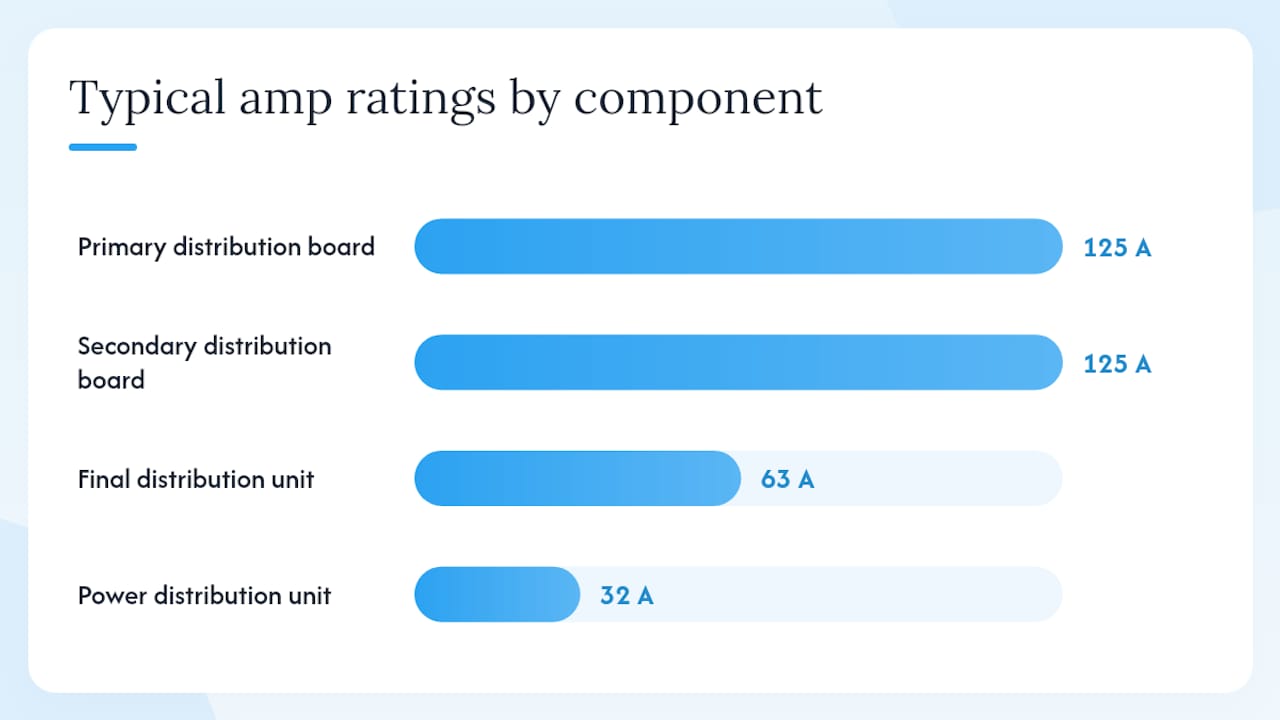
The term covers three distribution levels: primary, secondary and final. Primary distribution takes the incoming supply from the mains incomer or generator and feeds large sub-circuits via a primary distribution board (PDB). Secondary distribution breaks those sub-circuits down further through secondary distribution boards (SDBs) positioned closer to the stage or production areas. Final distribution delivers power to the actual loads through final distribution units (FDUs), socket boxes and PDUs.
For a fuller breakdown of how these levels interact, the event power distribution explained guide covers the hierarchy in plain terms for producers.
Common event applications and how their needs differ:
- Live concerts and touring shows: high aggregate loads from moving lights, audio amplifiers and video walls; typically three-phase supplies with 125 A or 63 A Ceeform incomers.
- Theatre productions: more predictable, repeatable loads; often fed from a venue’s existing distribution with supplementary FDUs for touring dimmer racks.
- Outdoor festivals: independent generator supplies are the norm; multiple stages require separate primary distribution runs with careful generator load balancing to avoid overloading any single generator.
- Film and TV location shoots: high demand for quiet power (low harmonic distortion); generators with AVR and power conditioning are common.
- Corporate conferences: generally lower loads but often in unusual venues with limited existing infrastructure; temporary power supply from a hired generator or venue board extension is typical.
A small theatre production might typically draw moderate power from a single 125 A three-phase venue supply. An outdoor festival main stage can draw significantly higher power across multiple generator sets. A corporate conference in a marquee generally requires lower power from a single 63 A three-phase feed. The distribution architecture scales accordingly, but the principles remain the same at every level.
What equipment makes up a stage power distribution system?
Every temporary distribution system shares a core set of components. The table below sets out the main hardware categories, their function and the typical specification you should be working to.
| Component | Function | Typical specification |
|---|---|---|
| Primary distribution board (PDB) | Receives the incomer supply and feeds secondary circuits | 125 A three-phase; MCCB protection; 125 A Ceeform connectors |
| Secondary distribution board (SDB) | Breaks primary feeds into zone sub-circuits | 63 A or 125 A three-phase; MCB or MCCB protection per outgoing way |
| Final distribution unit (FDU) / socket box | Delivers power to individual loads | 32 A or 63 A three-phase; 30 mA RCD per outgoing circuit; BS EN 60309 sockets |
| PDU (power distribution unit) | Rack-mounted or portable final distribution for technical equipment | 32 A single-phase; individual MCB per outlet; often with metering |
| RCDs and RCBOs | Fault and earth-leakage protection | 30 mA at final circuits; 100–300 mA at distribution level with correct discrimination |
| Flexible cables | Power feeds between distribution levels | HO7RN-F rubber-sheathed flexible; sized for load and voltage drop |
| BS EN 60309 connectors | Industrial-rated plugs and sockets | 32 A, 63 A, 125 A; colour-coded by voltage; IP44 minimum outdoors |
GS50 is clear that where higher power is needed, BS EN 60309 industrial outlets should be used rather than domestic 13 A sockets. That guidance exists for good reason: a 13 A socket is not rated for sustained high-current loads and offers no mechanical locking to prevent accidental disconnection.
Key points on protection devices:
- MCCBs (moulded-case circuit breakers) protect primary and secondary levels and provide fault current interruption at high ratings.
- MCBs protect individual final circuits within FDUs and PDUs.
- RCBOs combine overcurrent and earth-leakage protection in a single device, useful where space is limited in FDUs.
- RCD discrimination means upstream devices (300 mA) must be time-delayed relative to downstream 30 mA devices so a fault on a final circuit trips only that circuit, not the whole distribution.
Domestic consumer units have no place in a professional event setup. BS 7909:2023 is unambiguous: equipment must be purpose-built, rated for repeated outdoor use and mechanically robust. A plastic consumer unit from a builder’s merchant is none of those things.
How do you design and plan a stage power distribution system?
Good design starts with a load schedule. Work through every load category systematically before you touch a single cable.
Step-by-step load calculation
- Lighting: list every dimmer rack, LED driver, moving light and effects unit with its rated wattage. Sum the total and apply a diversity factor of 0.8 for dimmer-controlled tungsten loads (they are rarely all at full simultaneously) but use 1.0 for LED and moving lights, which draw near-constant current.
- Audio: front-of-house amplifiers, monitor amplifiers, subwoofers and signal processing. Use the rated power consumption from the spec sheet, not the output wattage. Apply a diversity factor of 0.7 for most live audio rigs.
- Backline: guitar amplifiers, keyboard rigs, in-ear monitor systems. These are often overlooked. Sum them and add 10% for unplanned additions.
- Catering and production: kettles, coffee machines, production office equipment and comms systems. These are constant loads; use a diversity factor of 1.0.
- Venue services: air conditioning, heating, CCTV and access control if fed from the temporary supply.
Sum the diversified loads to get your design demand in kW. For event lighting power consumption, the calculation deserves particular care because lighting loads can spike during cue-intensive sequences.
Worked example (mid-size outdoor concert, single stage):
That points to a 250 kVA generator minimum, fed into a 400 A three-phase PDB.
Topology and cable sizing
For most events, a radial (tree) topology works well: one PDB feeds multiple SDBs, each SDB feeds multiple FDUs. Ring topologies add resilience but complicate protection discrimination and are rarely justified below festival scale. A grid topology (multiple PDBs cross-connected) suits large multi-stage festivals where generator load balancing across sets is critical.
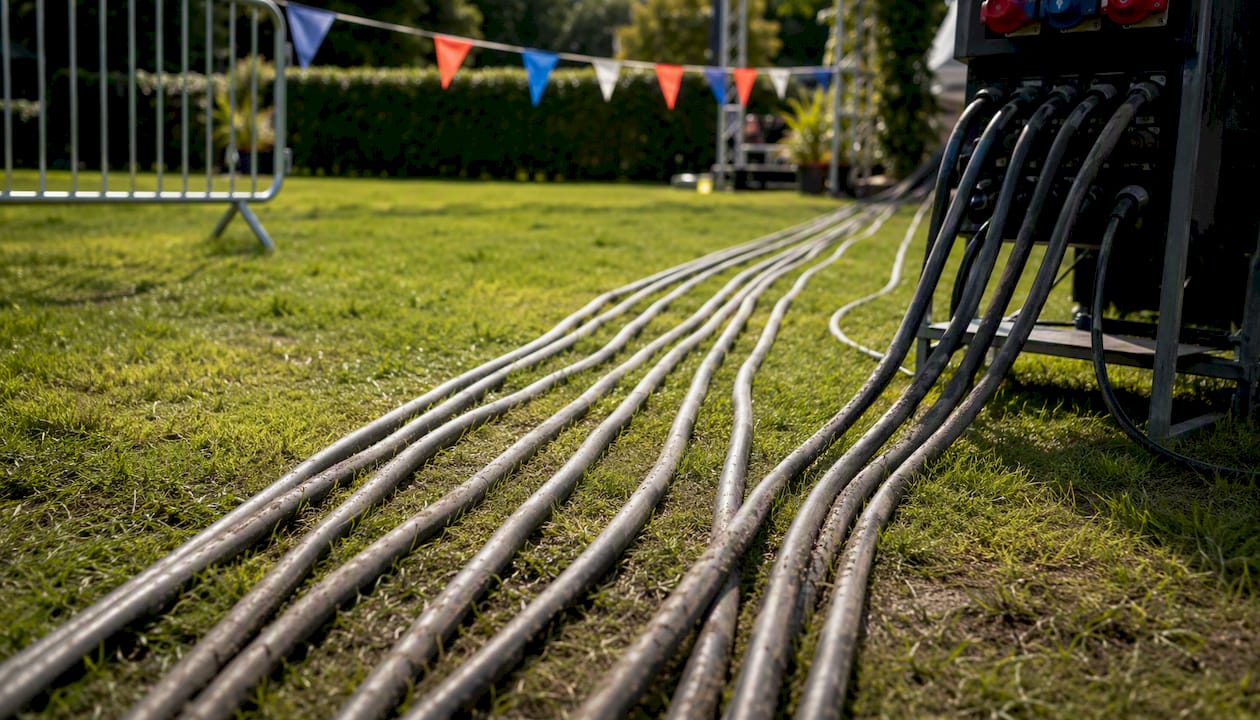
Cable sizing must account for both current-carrying capacity and voltage drop. For temporary HO7RN-F runs over 50 m, voltage drop becomes the governing factor rather than thermal rating.
Pro Tip: Always document your primary, secondary and final distribution runs in a schematic before site. A clear event electrical schematic lets every technician on site understand the system and allows fast fault diagnosis under pressure.
For generator supplies, synchronisation between multiple sets requires careful attention to phase rotation and frequency stability. Paralleling generators without proper synchronisation equipment risks catastrophic damage to both generators and connected equipment.
What UK safety and regulatory requirements must you follow?
Event organisers and electrical contractors both carry legal duties under UK health and safety law to do what is reasonably practicable to keep people safe. Following published HSE guidance is the most reliable way to demonstrate compliance in practice.
The key standards and their scope:
- BS 7909:2023 (+A1:2024): the code of practice for temporary electrical systems in entertainment. It covers supply planning, RCD requirements, power quality (including the new Annex K on power quality symptoms) and battery storage. This is the primary reference for any temporary event power system in the UK.
- BS 7671 (IET Wiring Regulations): the overarching UK wiring standard. BS 7909 sits alongside it and provides entertainment-specific guidance where BS 7671 is silent or general.
- BS EN 60309: the standard governing industrial plugs and sockets. Colour-coding (blue for 230 V, red for 400 V three-phase) and IP ratings are defined here.
- HSE GS50: practical guidance on electrical safety at places of entertainment, including socket provision and RCD placement.
- INDG247: a short HSE leaflet for entertainers and small production teams covering basic electrical safety measures.
Practical compliance requirements:
- All electrical work on temporary installations must be carried out by, or under the direct supervision of, a competent person. “Competent” means qualified, experienced and registered with a recognised body.
- Final circuits and socket-outlet circuits up to 32 A must be protected by a 30 mA RCD. Distribution-level RCDs can be rated at 100–300 mA provided correct discrimination is designed in, per IET guidance.
- Generator supplies almost always require a TT earthing arrangement with a separate earth electrode. PME (protective multiple earthing) from a TN-C-S network is generally unsuitable for outdoor temporary setups and should not be extended to a generator supply without specific engineering assessment.
- Commissioning records, test certificates and risk assessments must be produced before the system goes live and retained for inspection.
Compliance callout: BS 7909:2023 is the current code of practice for temporary electrical systems in entertainment and provides updated guidance on RCDs, planning supplies, power quality and battery storage. Practitioners should review the new Annex K on power quality symptoms, which addresses harmonic distortion and voltage fluctuation issues common in generator-fed event systems.
How should you install a temporary stage power system on site?
Installation is where planning either pays off or falls apart. The hierarchy of PDB to SDB to FDU must be physically reflected in how equipment is positioned on site.
Site setup and positioning:
- Place the PDB as close as practical to the generator or mains incomer to minimise primary cable runs and voltage drop.
- Position SDBs at the boundary between public and performer areas, or at the base of each stage structure, so that each zone can be isolated independently.
- Keep distribution equipment accessible to authorised personnel only. Lock distribution boards and use barriers or signage to prevent public access.
- Segregate power cables from data and audio cables wherever possible. Crossing at 90 degrees is acceptable; running parallel for extended distances causes interference.
Cable routing and mechanical protection:
- All cables crossing pedestrian routes must be covered with ramp covers or run overhead at a minimum height of 2.4 m. Flat-profile cable ramps are preferable to raised ones in high-footfall areas.
- Outdoor cables must be rated for outdoor use (HO7RN-F as a minimum) and positioned to avoid standing water, vehicle routes and heat sources.
- IP44 is the minimum rating for outdoor connectors and distribution equipment; IP65 is preferable in exposed locations or where rain is likely. For event cabling reliability, mechanical protection is as important as the cable’s electrical rating.
Connector practice and labelling:
- All BS EN 60309 connectors must be fully engaged and locked before energisation. A partially inserted Ceeform connector can arc under load.
- Label every circuit at both ends: distribution board and load. Use consistent colour-coding that matches your schematic. Tape labels degrade outdoors; use cable-tie labels or engraved tags for anything that will be rained on.
- Never use MCBs or MCCBs for routine load switching. They are protection devices, not switches. For regular switching of stage outlets, use contactors or motorised MCCBs rated for AC23 duty, as technical guidance confirms.
Pro Tip: Photograph every distribution board, cable run and connector before energisation. If a fault develops during the event, those photographs are your fastest diagnostic tool and your best evidence for any post-event investigation.
Testing, commissioning and documentation
No temporary distribution system should be energised without a structured commissioning process. This is not bureaucracy; it is the point at which you confirm the system is actually safe.
Pre-energisation checks (in order)
- Visual inspection: confirm all equipment is undamaged, correctly rated, properly connected and labelled. Check that all connectors are fully engaged and locked.
- Polarity check: verify phase, neutral and earth connections are correct at every distribution point. A reversed neutral on a three-phase system causes serious problems.
- Continuity of protective conductors: confirm the earth path is intact from every socket back to the main earth point.
- Earth electrode resistance: for TT generator supplies, measure the resistance of the earth electrode. The value must be low enough to ensure the RCD will operate within its rated parameters.
- Insulation resistance: where practicable, test insulation resistance on de-energised circuits before energisation.
- RCD operation: test every RCD using a calibrated RCD tester. Record the trip time and current. A 30 mA RCD must trip within 40 ms at 150 mA (5× rated current). Test the integral test button as well, but note that the button test does not verify the actual trip current.
Commissioning sign-off and records
Documents to produce and retain:
- Completed test schedule with measured values for each circuit (continuity, earth loop impedance, RCD trip time and current).
- Visual inspection record signed by the responsible person.
- Schematic drawing of the distribution system as installed.
- Risk assessment covering the electrical installation.
- Copy of the contractor’s public liability insurance and relevant qualifications.
The responsible person (the competent electrician overseeing the installation) must sign off the commissioning record before any circuit is energised for use. For event electrical equipment inspection requirements, PAT records for portable equipment should be available alongside the commissioning documentation.
The venue or event organiser should receive a copy of the commissioning record. Keep the original for at least three years.
Common on-site problems and how to fix them
Even well-planned systems develop faults. Knowing the likely cause before you start tracing saves time when the show is 20 minutes from doors.
Voltage drop:
- Symptoms: lamps dimmer than expected, audio amplifiers clipping at lower output levels than normal, moving lights reporting low-voltage errors.
- Likely causes: undersized cable for the run length, loose connector, or higher actual load than the design assumed.
- Triage: measure voltage at the load and at the distribution board. If the difference exceeds 3%, the cable or connector is the problem. Check all connectors for heat (a warm connector under load indicates high resistance). Substitute a shorter or larger-section cable if available.
Nuisance RCD tripping:
- Symptoms: an RCD trips without an obvious fault; resetting it holds for a while before it trips again.
- Likely causes: accumulated earth leakage from multiple items of equipment on the same circuit (each item has a small leakage current; they add up), a damaged cable with moisture ingress, or incorrect discrimination between upstream and downstream RCDs.
- Triage: disconnect loads one at a time and reset the RCD after each removal. When the RCD holds, the last item removed is the problem. If the RCD trips immediately on reset with no loads connected, the cable itself is faulty. Check IP ratings on all connectors and look for water ingress.
Circuit overloads:
- Symptoms: MCB trips repeatedly; equipment on the circuit loses power.
- Likely causes: more load connected than the circuit is rated for, or a fault in one piece of equipment drawing excess current.
- Triage: calculate the actual load on the circuit from the connected equipment. If it exceeds the MCB rating, shed load to another circuit. If the load is within rating, suspect a faulty piece of equipment and substitute it.
When to escalate or take a circuit out of service:
If an RCD trips and cannot be reset, or if a circuit shows signs of overheating (discoloured connectors, burning smell, tripped thermal protection), take it out of service immediately. Do not bypass protection devices. Document the action: note the time, the circuit affected, the symptom and the action taken. Inform the venue and the event organiser. If the fault cannot be safely diagnosed and rectified before the event, the circuit stays off.
How do you choose a competent event power contractor?
The contractor you appoint carries significant responsibility. Choosing on price alone is a false economy when the alternative is a tripped distribution board during a headline set or, worse, a safety incident.
Credentials to require
- Qualified electricians on the team, registered with a recognised body such as the NICEIC, ECA or SELECT (Scotland).
- Specific experience with temporary entertainment electrical installations, not just domestic or commercial work.
- Public liability insurance with adequate cover for the scale of your event.
- Evidence of working to BS 7909:2023 and BS 7671.
- PAT testing records for all portable equipment they supply.
- References from comparable events (similar scale, similar venue type).
Questions to ask before appointing
- Can you provide a schematic of the proposed distribution system before site?
- Who will be the responsible person on site during build, live event and load-out?
- What commissioning tests will you carry out and what records will you provide?
- How do you handle generator earthing for outdoor events?
- What is your escalation procedure if a fault develops during the live event?
Red flags to walk away from:
- Proposed use of domestic consumer units or 13 A extension leads as primary distribution.
- Inability or unwillingness to provide commissioning records or test certificates.
- No named responsible person for the electrical installation.
- Reluctance to follow BS 7909 guidance or unfamiliarity with it.
- No public liability insurance documentation available.
HSE guidance on managing an event is explicit: build-up and load-out phases carry some of the highest electrical risk of the entire event. A contractor who treats those phases as less important than the live period is not the right contractor. For events involving hospitality functions, the role of event electricians at weddings guide covers the specific duties and safety measures that apply in those settings.
The planning mistakes that actually cost you on the day
Most electrical failures at live events are not random. They are the predictable result of decisions made weeks earlier, usually under time pressure or budget pressure, that nobody challenged at the time.
The most common planning mistake is treating the load schedule as a formality rather than a working document. The distribution is undersized before a cable has been laid.
The second mistake is underestimating build and load-out risk. The HSE is clear that these phases are often more dangerous than the event itself. Cables are being moved, connectors are being made and broken, and the system is being partially energised while work continues around it. Competent supervision must be present throughout, not just for the commissioning sign-off.
The one habit worth building into every event: a single commissioning sign-off sheet, signed by the responsible electrician, that travels with the event file. It takes ten minutes to complete and it is the clearest possible evidence that the system was checked before it went live. Without it, you are relying on memory and goodwill if anything is questioned afterwards.
Jakspartypower: event power you can rely on in Sussex and beyond
Forty years of electrical contracting experience is a long time to learn what goes wrong on site. Jakspartypower brings that experience to every event, from a 30 kW marquee wedding supply to a multi-generator festival distribution system.

The service covers the full distribution chain: generator hire (single-phase and three-phase), primary and secondary distribution boards, FDUs, cabling, connectors and on-site standby support throughout your event. Every installation is commissioned to BS 7909:2023 and BS 7671, with test records and a signed commissioning sheet supplied as standard. For events where continuity matters, the standby service for corporate events keeps a qualified electrician on site from build through to load-out.
If you are specifying a distribution board installation or need a complete temporary power solution for your next event, get in touch with Jakspartypower for a quote.
Sources
- BS 7909:2023 Temporary electrical systems for entertainment and related purposes – BSI Knowledge
- Electrical safety at places of entertainment (GS50) (HSE)
- Temporary power distribution systems and electrical supplies for entertainment-related purposes (IET)
FAQ
What is stage power distribution?
Stage power distribution is the system that takes an incoming electrical supply (mains or generator) and divides it into protected, labelled circuits for lighting, audio, stage effects and venue services, using a hierarchy of primary, secondary and final distribution boards.
What are the three main levels of event power distribution?
Primary distribution receives the incomer supply and feeds large sub-circuits; secondary distribution breaks those into zone feeds; final distribution delivers power directly to loads via socket boxes and PDUs. Each level carries its own protection devices and connectors rated for that current level.
What is a PDU and how does it work?
A PDU (power distribution unit) is a rack-mounted or portable final distribution device that takes a single incoming feed and divides it into multiple individually protected outlets, typically with MCBs per outlet and sometimes with metering. It sits at the final distribution level, closest to the equipment it powers.
What RCD protection is required for stage power circuits?
Final circuits and socket-outlet circuits up to 32 A must be protected by a 30 mA RCD, per BS 7909:2023 and IET guidance. Distribution-level RCDs can be rated at 100–300 mA provided correct time-delay discrimination is designed in so a final-circuit fault trips only that circuit.
How do you earth a generator supply for an outdoor event?
Generator supplies for outdoor temporary installations almost always require a TT earthing arrangement with a dedicated earth electrode driven at the generator. PME from a TN-C-S network is generally unsuitable for outdoor temporary setups; the IET guidance on temporary power distribution covers the specific requirements for electrode resistance and RCD coordination.