
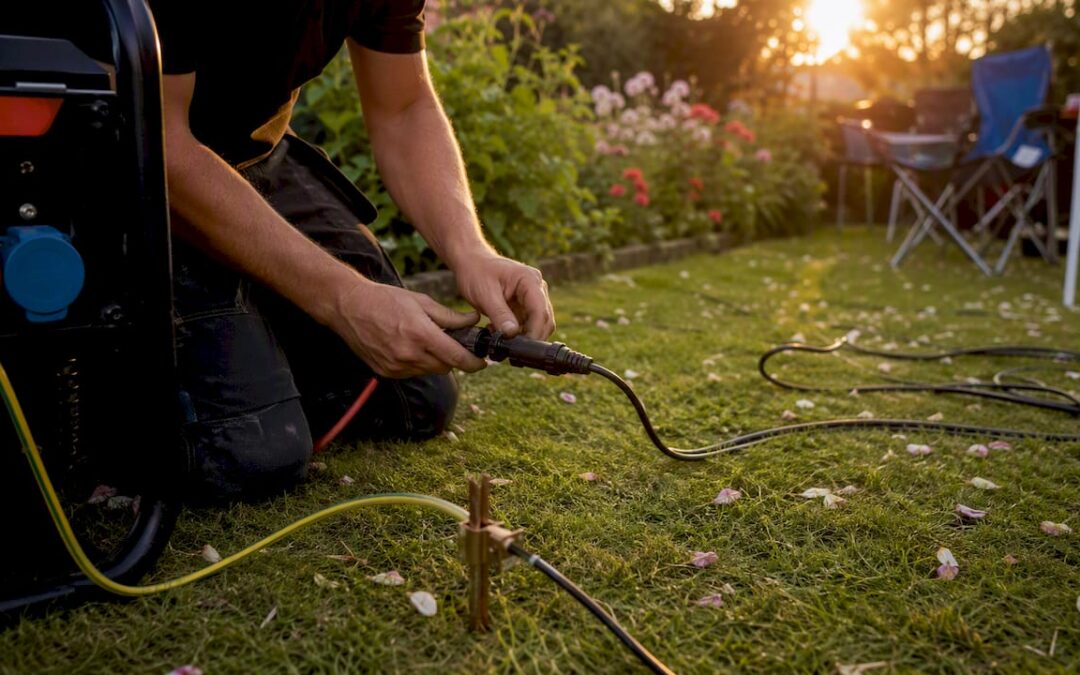
For any outdoor event in the UK, safe and compliant temporary power comes down to three non-negotiable actions: appoint a named Senior Person Responsible (SPR), confirm the installation follows BS 7909 and BS 7671, and verify generator earthing and RCD protection before a single cable goes live. These are not optional extras. Under HSE guidance, event organisers are duty holders who must do all that is reasonably practicable to keep temporary electrical installations safe. That duty sits with you, not your contractor.
The term “backyard party electrical best practices” is widely used in planning circles, but the industry standard for this work is temporary event power, governed by BS 7909:2023 and the IET Wiring Regulations (BS 7671). Whether you are running a wedding marquee in a Sussex field or a corporate dinner in a walled garden, the same framework applies.
Five immediate actions before any hire or energisation:
- Appoint a named SPR in writing and confirm the role is accepted before the event date.
- Request equipment test certificates (EICR, PAT where applicable, earth resistance test) from every contractor and hire company.
- Commission a site survey to identify load requirements, buried services, and weather exposure.
- Obtain a written generator earthing check confirming the earthing electrode and neutral/earth bonding arrangement.
- Confirm RCD protection on all final circuits (30 mA) and verify upstream discrimination before energisation.
Pro Tip: Ask your supplier to send the commissioning sign-off sheet and copies of all test certificates before the event opens to the public. If they cannot produce these documents, the installation is not ready.
Key takeaways
Compliant outdoor event power requires a named SPR, BS 7909/BS 7671-aligned design, verified generator earthing, and signed commissioning paperwork before any public access.
| Point | Details |
|---|---|
| Appoint an SPR in writing | Name the Senior Person Responsible in the contract before any hire is confirmed. |
| Verify earthing before energisation | Obtain a measured earth resistance test result for the generator electrode as a condition of commissioning. |
| 30 mA RCDs on all final circuits | Upstream devices use higher-rated, time-delayed RCDs for discrimination; never bypass any device. |
| Sign off commissioning before gates open | No public access until the SPR signs the commissioning sheet with test results and energisation time. |
| Jakspartypower for compliant Sussex events | Jakspartypower provides site survey, generator hire, earthing tests, commissioning sign-off, and standby cover. |
Table of Contents
- What should you check before booking a hire or contractor?
- How do you calculate demand and choose the right generator size?
- Who is responsible, and what competence evidence should you request?
- What are the generator earthing and bonding rules you must verify?
- How should RCD protection be set up for temporary event power?
- What distribution boards, connectors, and cables do you need?
- What testing and commissioning must happen before the event opens?
- How do you manage weather risk, standby services, and supply resilience?
- What should you do when an electrical fault or emergency occurs?
- What event organisers consistently get wrong about temporary power
- Jakspartypower: compliant event power, from site survey to standby
- Sources
- FAQ
What should you check before booking a hire or contractor?
Getting the pre-booking stage right saves far more time than fixing problems on site. The checklist below is designed to be used when evaluating quotes, not after you have signed a contract. Refer to the event equipment hire checklist for a fuller version you can take into supplier conversations.
What to request from every supplier and contractor:
- Evidence of electrical competence: NVQ Level 3 in Electrotechnical Technology, City & Guilds 2382 (BS 7671 wiring regulations), or equivalent demonstrable experience on comparable event installations.
- Public liability insurance certificate (public liability insurance certificates of an appropriate level are typically required for UK event venues; confirm your venue’s requirement).
- PAT records for all portable equipment being brought on site, plus EICR or in-service test records for distribution boards and cables.
- A written generator fuel plan: fuel type, tank capacity, refuelling schedule, and the name of the person responsible for refuelling.
- A method statement and risk assessment specific to your site, not a generic template.
- Confirmation of who will be named as SPR and their contact details for the event day.
What you must provide to the supplier:
- A load timetable: which equipment runs at which times, including peak demand periods (e.g. catering service, lighting rigs, PA systems).
- Site access details: vehicle access routes, ground conditions, proximity to existing supplies, and any overhead or underground services.
- Weather exposure: is the site open to prevailing wind, rain, or flooding risk? Are there trees that create lightning risk?
- Locations of any existing electrical supplies, including the DNO cut-out and any buried services (request a utility search if in doubt).
Pro Tip: Name the SPR in the contract and make delivery of the commissioning paperwork a condition of final payment. This single clause changes the conversation with every supplier.
The role of electrical contractors at events is more specific than general electrical work. Not every qualified electrician has experience with temporary event distributions, generator earthing, or BS 7909. Ask for references from comparable events, not just domestic or commercial projects.
How do you calculate demand and choose the right generator size?
Running a generator at or above its rated capacity causes overheating, voltage instability, and premature failure.
For event lighting power consumption and other load categories, the worked example below gives a realistic starting point for a medium-sized outdoor party.
Worked example: typical outdoor party load estimate
For this load profile, a generator in the 20 kVA class is the minimum sensible choice. A 6 kVA single-phase trolley generator such as the Pramac units commonly used in UK events suits very small private parties with a single PA, basic lighting, and no catering. Once catering or a full lighting rig enters the picture, you need to step up.
Generator size bands for outdoor events
The IET guidebook on temporary electrical systems provides worked earthing calculations and distribution design examples for larger installations. For anything above 25 kVA, commission a formal load schedule from a competent electrical engineer before finalising the hire specification.
Power zoning: why it matters more than total capacity
Dividing the site into power zones is as important as getting the total kW right. Critical circuits (stage, emergency lighting, medical) should run on dedicated supplies, separate from catering and bar loads. This prevents a tripped breaker in the kitchen from killing the stage mid-performance. Emergency lighting must have its own supply or battery backup, independent of the main event distribution.
Diversity factors apply: not every load runs simultaneously at full draw. A competent designer will apply diversity to the load schedule, but organisers should understand that diversity does not mean undersizing. The safety margin absorbs the gap between calculated diversity and real-world behaviour.
Pro Tip: Never accept a proposal that involves paralleling two generators or connecting to the public supply without a written approval from a qualified electrical engineer and, for public supply paralleling, written agreement from your electricity supplier. The earthing implications alone make this a specialist task.
For larger events, the outdoor festival power setup guide covers multi-zone design and the sequencing of loads across a site.
Who is responsible, and what competence evidence should you request?
Organisers are duty holders. That is the direct answer, and it does not change because you have hired a contractor. Under HSE electrical safety guidance, event organisers, contractors, and others using electrical equipment must do all that is reasonably practicable to ensure installations are properly selected, installed, and maintained so as not to cause death or injury. You can delegate the technical work; you cannot delegate the duty.
The Senior Person Responsible is the individual named in the project documents as accountable for the electrical installation throughout the event. The SPR must be explicitly appointed in writing. Do not assume the hire company or contractor automatically fills that role unless it is agreed in the contract. The BBC safety guidance on temporary electrical systems reiterates this point clearly: the SPR appointment is a specific, named, documented role, not an implied one.
Competence checklist: what to request from contractors
- Formal electrical qualification: NVQ Level 3 Electrotechnical Technology, City & Guilds 2382 (18th Edition), or equivalent, plus evidence of relevant event experience.
- Public liability and professional indemnity insurance certificates.
- References or portfolio from at least two comparable outdoor event installations.
- Written method statement and risk assessment for your specific site.
- PAT records for all portable equipment and EICR or in-service test records for distribution boards.
- Confirmation of who will act as SPR and their availability throughout the event.
Documents to obtain and retain before the event
- EICR (Electrical Installation Condition Report) or in-service test records for all hire distribution equipment.
- Commissioning sign-off sheet, signed by the SPR or competent person, before public access opens.
- Generator maintenance log and fuel log, updated on the day.
- Earth resistance test result for the generator earthing electrode.
- SPR appointment letter or written confirmation, naming the individual and their contact details.
For a detailed breakdown of what inspection records should contain, the event electrical equipment inspection guide covers the key items.
Handover protocol
The commissioning sign-off is not just a paperwork exercise. Require the SPR’s name and direct contact number on the written site handover document, and make it explicit that public access to the event site does not open until the commissioning sheet is signed. This single protocol has prevented more incidents than any other single measure in professional event power management.
Pro Tip: Include a clause in the hire contract that the SPR must be physically present on site during energisation and commissioning, not just available by phone. Remote sign-off is not adequate for a live event installation.
What are the generator earthing and bonding rules you must verify?
Before energisation, verify that the generator has an appropriate earthing electrode installed and that an earth resistance test has been carried out and recorded. That is the non-negotiable starting point. Building earthing systems are not a substitute for a dedicated generator earth, and assuming otherwise is one of the most common and dangerous mistakes on temporary event sites.
GS50 sets out the practical measures for temporary installations at events, including the requirement for earthing tests and the retention of documentation. The IET guide to temporary power systems has been updated to reflect modern generator earthing practice, including guidance on neutral/earth bonding arrangements and the implications of different earthing system types (TN-S, TN-C-S, TT) for temporary supplies.
Mandatory earthing checks to request from your supplier
- Earth resistance test result for the generator earthing electrode, with the test method and instrument used recorded.
- Written confirmation of the neutral/earth bonding arrangement: where the N-E bond is made, and whether it is a TN or TT system.
- Wiring diagrams showing the bonding arrangement, any neutral switching, and the connection between the generator and distribution.
- Generator output protection settings: overcurrent protection ratings and any earth fault protection on the generator output.
- Confirmation that the generator frame is bonded to the earthing electrode.
Neutral/earth bonding: the practical rule
For a standalone generator supplying a temporary event installation, the neutral/earth bond is typically made at a single point, at the generator itself. This creates a TN-S or TT system depending on the earthing electrode arrangement. The critical rule is that there must be only one N-E bond in the system. Multiple bonding points create circulating currents and can cause RCDs to trip spuriously or, worse, to fail to trip when needed.
Do not connect a generator in parallel with the public supply without written agreement from the electricity supplier and a formal earthing strategy signed off by a qualified electrical engineer. The prohibition is absolute in BS 7909:2023. The earthing implications of paralleling two sources are not something to resolve on the day.
Pro Tip: Insist on an on-site earthing test certificate as a mandatory item in the commissioning pack. If the supplier cannot produce a test result with a measured earth resistance value, the generator is not ready to energise.
For hiring a generator for private events, the earthing requirements are the same regardless of generator size. A 6 kVA unit needs a proper earth electrode just as much as a 100 kVA unit does.
How should RCD protection be set up for temporary event power?
Final circuits supplying portable equipment must be protected by 30 mA RCDs. Upstream devices use higher-rated RCDs with time-delay or current discrimination to prevent a single fault from taking down the entire site. That is the core of a correctly designed protection strategy, and it is what BS 7909:2023 and BS 7671 require for temporary event distributions.
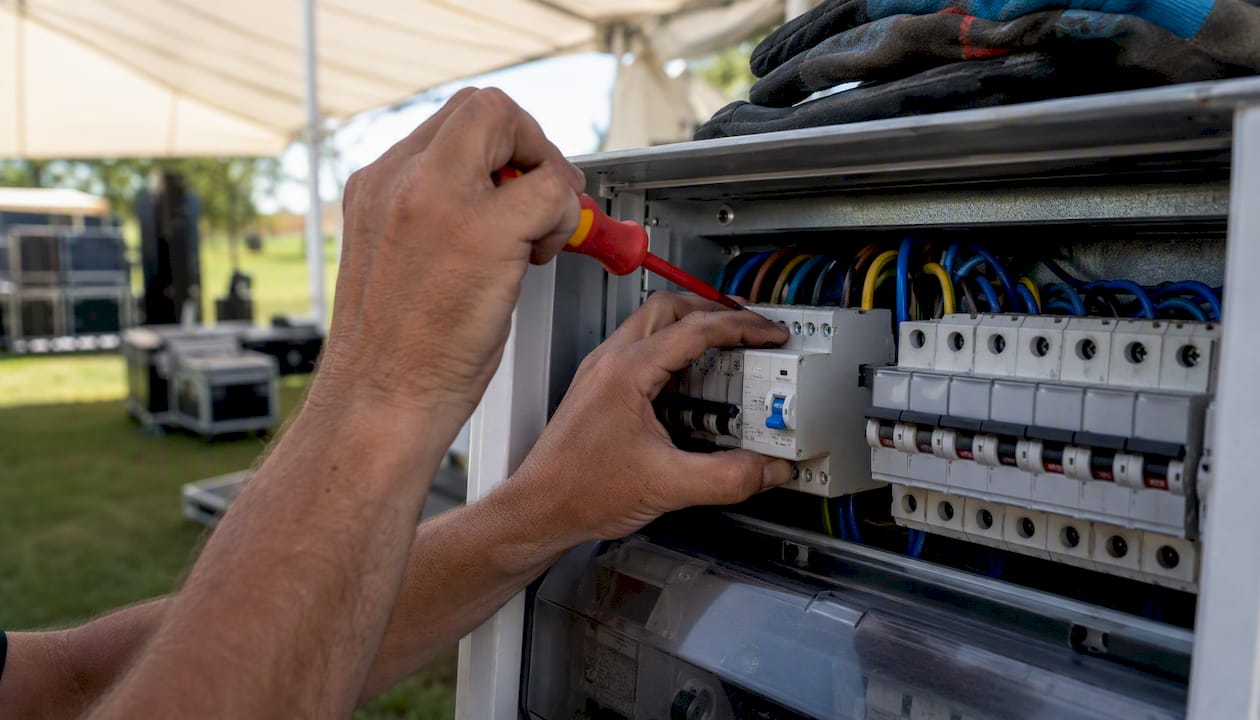
The IET guidebook covers RCD selection and discrimination in detail. The BBC safety guidance confirms that all final circuits should have 30 mA RCD protection, and notes that for small or simple systems under 6 kW, the checks are simplified but the 30 mA requirement still applies.
How tapered protection works in practice
Tapered (or cascaded) RCD protection means that devices at different levels of the distribution hierarchy have different sensitivity and time settings, so that a fault on a final circuit trips only the closest upstream device, not the main supply. An illustrative example for a medium event:
- Generator output protection: 300 mA, time-delayed (S-type) RCD or RCCB, protecting the entire site supply.
- Sub-distribution board (zone level): 100 mA RCD, instantaneous or short time-delay, protecting a zone (e.g. catering, stage).
- Final circuit (socket outlets): 30 mA RCD, instantaneous, protecting individual portable equipment.
This arrangement means a fault on a catering socket trips the 30 mA device on that circuit. If that device fails to operate, the 100 mA zone device operates next. The 300 mA generator-level device is the last resort, and its time delay gives the downstream devices a chance to clear the fault first.
Practitioner discussion in the IET EngX forum notes that Regulation 551.4.4.2 requires every final circuit to have additional protection by means of an RCD, and that a single upstream 30 mA RCD can be acceptable if every final circuit is downstream of it. However, for any installation with multiple distribution boards, a single upstream device without discrimination means a single fault can black out the whole site. Tapered protection is the professional standard.
Common pitfalls to avoid
- Bypassing RCDs to prevent nuisance tripping: this removes the primary protection against electric shock and is never acceptable.
- Using a single upstream RCD without downstream discrimination: one fault blacks out the site.
- Failing to check manufacturer advice for vibrating or motor-driven equipment: some equipment types cause nuisance tripping on standard 30 mA devices and may require a different approach (e.g. Type A or Type F RCDs for variable-speed drives).
- Not labelling RCDs on distribution boards: stewards and operations staff must be able to identify which device protects which circuit without calling an electrician.
Commissioning verification checklist for RCD protection
- Test every RCD using the test button and a calibrated RCD tester before energisation.
- Record the trip time for each device and confirm it is within the manufacturer’s specification.
- Verify discrimination between upstream and downstream devices using the supplier’s scheme diagram.
- Confirm all RCDs are labelled with the circuit or zone they protect.
- Check that no RCDs have been bridged or bypassed.
Pro Tip: Ask your supplier for a discrimination diagram as part of the commissioning paperwork. This single document shows every RCD in the system, its rating, its time setting, and how it coordinates with adjacent devices. If the supplier cannot produce one, the protection strategy has not been properly designed.
What distribution boards, connectors, and cables do you need?
Specify distribution boards and connector types to match the load and the outdoor environment. Improvised connections, domestic extension leads, and unprotected cable joints are the three most common causes of electrical incidents at outdoor events. None of them belong on a professional temporary installation.
For a full overview of distribution equipment options, the role of distribution boards at large events covers selection criteria and site layout considerations.
BS EN 60309 connector types and typical event uses
BS EN 60309 industrial connectors are the standard for temporary event power in the UK. They are colour-coded by voltage and rated current, which makes identification straightforward on a busy site.
| Connector rating | Colour (single-phase) — voltage not specified | Typical event use |
|---|---|---|
| — | Blue | Small lighting circuits, single PA speakers, laptop charging |
| — | Blue | Stage monitors, bar refrigeration, medium lighting rigs |
| — | Blue | Main stage power feeds, large catering equipment |
| — | Blue | Primary distribution feeds between boards |
| — | Red (three-phase) — voltage not specified | Three-phase catering, large motor loads |
| — | Red (three-phase) — voltage not specified | Main three-phase feeds, large stage rigs |
Never mix connector types or use adaptors to connect equipment rated for a lower current to a higher-rated outlet. The connector rating must match or exceed the equipment’s demand.
Cable selection: what matters for outdoor temporary installations
Outdoor temporary distributions require flexible cables rated for the load and the environment. The IET guidebook notes that temporary distributions require different design thinking to fixed installations: ambient de-rating, flexible conductor correction factors, and mechanical protection methods rather than armoured cable are the key considerations.
Key points on cable selection:
- Use Class 5 flexible conductors (fine-stranded) for all portable assemblies; these tolerate repeated coiling and uncoiling without conductor fatigue.
- Apply correction factors for ambient temperature and grouping: cables lying on warm ground in direct sunlight carry less current than their rated value in free air.
- Never use coiled extension leads on drums at full load: a 25-metre drum coiled and carrying significant current will overheat. Fully unroll drums before use.
- Size cables for the full circuit length, not just the load: voltage drop across long cable runs can cause equipment malfunction and overheating.
Cable routing and mechanical protection
- Use cable ramps at every pedestrian crossing point. Ramps rated for pedestrian traffic are not the same as those rated for vehicles; specify the right type for each location.
- Suspend cables on catenaries (overhead runs) where ground routing is impractical, at a minimum clearance of 5.2 metres over vehicle routes and 2.5 metres over pedestrian areas (confirm with your engineer for site-specific requirements).
- Segregate power cables from audio and data cables to prevent interference and to make fault-finding easier.
- Keep cables away from vehicle routes where possible; where crossing is unavoidable, use heavy-duty protection rated for the vehicle weight.
- Label every cable at both ends and at intermediate distribution points. On a dark site at 2 AM, unlabelled cables are a serious operational problem.
- Never bury cable joints in the ground or conceal them under matting without a proper weatherproof enclosure.
Pro Tip: Insist on purpose-built portable distribution boards with integral RCD protection and clear circuit labelling in the hire contract. A distribution board that arrives on site without labelled circuits or with RCDs already tripped is a red flag. Reject it and request a replacement.
For cable hire and protective accessories including ramps and ducting, confirm with your supplier that the cable ratings and protection types match your site survey before delivery.
What testing and commissioning must happen before the event opens?
No live public access until commissioning tests are complete and the results are signed off by the SPR or a competent electrical person. That is the rule, and it is not negotiable. Opening a site before commissioning is complete is the point at which organisers move from a planning failure to a legal liability.
GS50 recommends specific practical checks including earthing tests, RCD testing intervals, and documentation to be retained, all of which should be included in the commissioning paperwork. The event electrical equipment inspection guide provides a detailed breakdown of what inspection records should contain for hire equipment.
Commissioning checklist: what must be done before energisation
- Visual inspection of all distribution boards, connectors, cables, and cable protection for damage, correct ratings, and correct labelling.
- RCD test on every device: test button check and timed trip test with a calibrated instrument; record results.
- Earth electrode resistance test: measure and record the resistance of the generator earth electrode; confirm it meets the design requirement.
- Insulation resistance test on distribution units and cables: confirm no breakdown between conductors or to earth.
- Continuity test on protective conductors: confirm the earth path is intact throughout the distribution.
- Load trial: energise the installation progressively, starting with the lowest loads, and confirm voltage and current readings are within expected ranges.
- Labelling verification: confirm every circuit, RCD, and isolator is correctly labelled before any load is connected.
Step-by-step commissioning sequence
- Complete all visual inspections before any power is applied.
- Carry out insulation resistance and continuity tests on de-energised equipment.
- Energise the generator and measure output voltage and frequency before connecting any distribution.
- Connect distribution boards progressively, testing RCDs at each stage.
- Apply loads in sequence, monitoring current draw against the load schedule.
- Record all test results on the commissioning sign-off sheet.
- SPR signs the sheet, noting the time of energisation and confirming the installation is safe for public access.
- Hand the signed sheet to the event operations manager before gates open.
Records to file on the event day
- Signed commissioning sign-off sheet with SPR name, test results, and time of energisation.
- EICR or in-service test records for all hire distribution equipment.
- PAT records for portable equipment where applicable.
- Generator maintenance log and fuel log, updated at each refuelling.
- Earth resistance test certificate.
Pro Tip: Create a one-page commissioning sign-off template that includes the SPR name, a summary of test results (earth resistance, RCD trip times, insulation resistance pass/fail), the time of energisation, and a signature block. Keep a copy on site throughout the event and retain it for at least three years for HSE and insurer purposes.
How do you manage weather risk, standby services, and supply resilience?
Review the weather forecast in the 48 hours before the event and put standby or failover plans in place for critical systems before the day arrives. A weather contingency that is written into the service agreement is worth ten times more than one that is improvised on the morning of the event.
The IET guide to temporary power systems now includes explicit procedures for managing temporary systems during lightning forecasts, reflecting the industry’s shift toward supply resilience and power quality management. For venues with a history of weather exposure, the event venue power redundancy examples guide covers practical resilience designs.
Practical resilience measures
- Lightning policy: establish a clear protocol for temporary systems during lightning risk. This includes when to de-energise non-essential supplies, who makes the decision, and how the decision is communicated to operations staff. The IET guidance covers this specifically for temporary installations.
- Battery/UPS for sensitive equipment: mixing desks, lighting control systems, and medical equipment benefit from UPS (uninterruptible power supply) protection. A brief generator interruption during a fuel changeover or fault clearance can corrupt show files or interrupt medical monitoring.
- Multiple generators: for events where supply loss is unacceptable (stage, emergency lighting, medical), specify two generators in an N+1 arrangement. One generator handles the load; the second is on standby and can be brought online within seconds. This is not the same as paralleling, which requires a formal earthing strategy.
- Fuel planning: calculate fuel consumption based on the generator’s rated output and the expected run time, then add a contingency reserve. A 20 kVA generator running at 60% load for 12 hours consumes roughly 30–40 litres of diesel; confirm the exact figure with your supplier for the specific unit.
Safe refuelling and fuel storage
Refuelling a running generator is a significant fire risk. The correct procedure is to stop the generator, allow it to cool briefly, refuel using an approved container and funnel, replace the cap securely, and restart. Never refuel near naked flames or smoking materials.
Fuel storage on site must comply with the Control of Pollution (Oil Storage) Regulations 2001 for quantities above 200 litres. For smaller quantities, store fuel in approved containers away from the generator, in a bunded area or secondary containment, and away from public access. The person responsible for refuelling must be briefed on the procedure and the fire response plan.
Document every refuelling in the generator fuel log: time, quantity added, who carried it out, and the generator’s running hours at the time of refuelling.
What a professional standby service provides
A standby service means a qualified electrician or electrical team is available on site or on rapid call throughout the event. For larger events, this includes a replacement generator on standby, refuelling capability, and continuous monitoring of the distribution. For the standby service for corporate events, the key deliverables are rapid fault response, generator monitoring, and the ability to switch to a backup supply without interrupting the event.
When to require standby cover in the contract:
- Events with a stage or live performance where supply loss would be immediately visible to the audience.
- Events with catering where a power interruption would cause food safety issues.
- Events with medical facilities or first aid posts.
- Any event running for more than eight hours, where generator maintenance or refuelling creates a supply interruption risk.
- Events in exposed locations with a high weather risk.
Pro Tip: Include a weather contingency clause in the service agreement that automatically triggers standby support if the Met Office forecast for the event location shows severe weather (wind above a defined threshold, lightning risk, or heavy rain) within 24 hours of the event. This removes the need for a last-minute negotiation when conditions deteriorate.
What should you do when an electrical fault or emergency occurs?
Identify and be able to isolate all supplies quickly. Every person in the operations team must know where the main isolators are, how to operate them, and who to call. This is not a task to leave to the electrician alone; it is a site-wide operational requirement.
Step-by-step electrical fault response
- Isolate the supply at the nearest labelled isolator. Do not attempt to diagnose the fault first. Isolation is always the first action.
- Call the SPR or lead electrician immediately. Give them the location, the nature of the incident (trip, smell, smoke, shock), and the current status (isolated or not).
- Evacuate the immediate area if there is any sign of fire, smoke, or ongoing electrical hazard. Do not allow anyone to re-enter until the SPR confirms it is safe.
- Secure the area with barriers and signage to prevent unauthorised access to the affected equipment.
- Call emergency services (999) if there is a fire, a person has received an electric shock, or the situation cannot be controlled by isolation alone.
- Log the incident immediately: time, location, nature of the fault, actions taken, and who was informed. This log is essential for HSE and insurer reporting.
- Do not re-energise any supply until the SPR or a competent electrician has inspected the fault, identified the cause, and confirmed the installation is safe.
Contact template for the site plan
Every event site plan should include a contact sheet with the following roles and information:
- SPR: name, mobile number, location on site during the event.
- Lead electrician: name, mobile number, location on site.
- Duty operations manager: name, mobile number, radio channel.
- Emergency services: 999 (and the site address in full for the call handler).
- DNO emergency line: for any incident involving the public supply (105 in the UK).
- Generator supplier: emergency contact number for the hire company.
Each person on this list must have a printed copy of the site electrical layout, showing the location of every main isolator, distribution board, and generator. A digital copy on a phone is useful; a laminated paper copy in a site box is essential.
Reporting and record retention
Keep the commissioning records, incident logs, and test certificates for a minimum of three years. HSE inspectors and insurers may request them following an incident, and the records are your primary evidence that the installation was properly designed, tested, and managed. If a RIDDOR-reportable incident occurs (a dangerous occurrence or an injury connected to the electrical installation), report it to the HSE within the required timeframe.
What event organisers consistently get wrong about temporary power
The most common planning mistake is treating the electrical specification as the last item on the production schedule rather than the first. By the time a venue is booked, a caterer is confirmed, and a lighting designer has submitted a rig plan, the power requirement is already determined. Bringing in an electrical supplier at that point and asking them to “make it work” is how sites end up with undersized generators, improvised cable runs, and no commissioning paperwork.
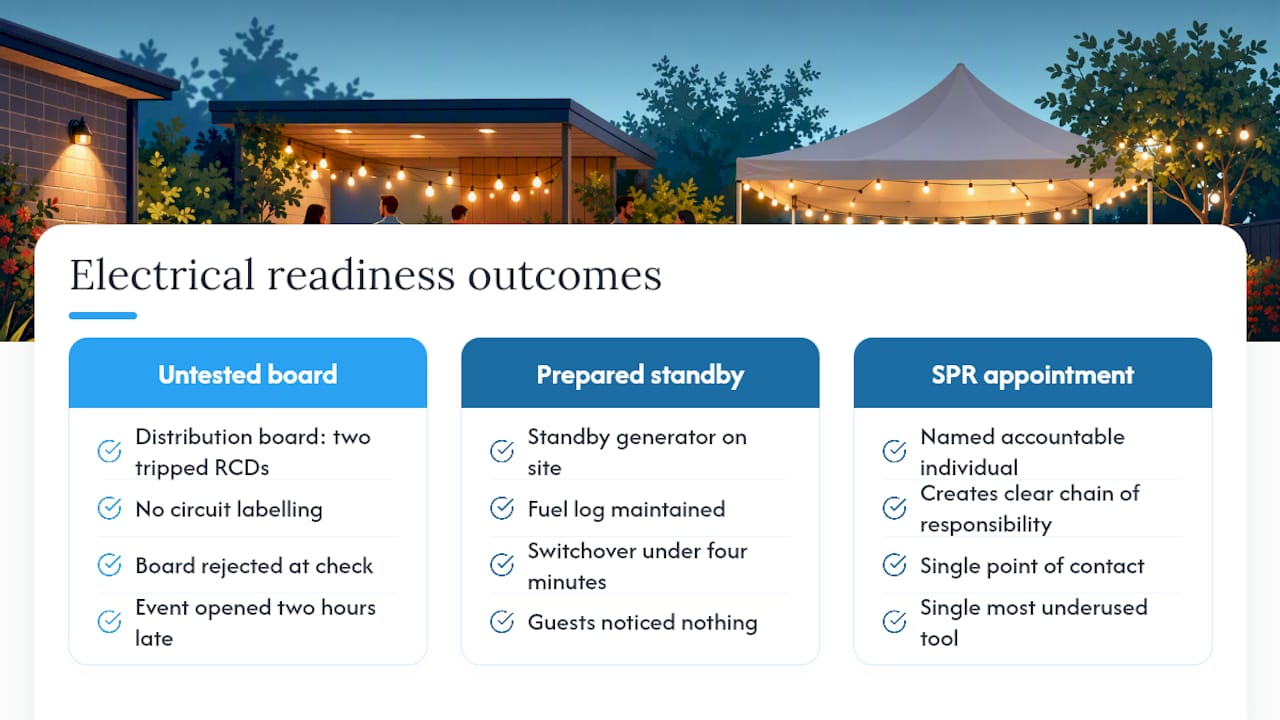
Two patterns come up repeatedly on professional event sites. In the first, a commissioning check before a large marquee wedding revealed that the distribution board supplied by the hire company had two RCDs already in a tripped condition and no labelling on any of the circuits. The board was rejected, a replacement was sourced, and the event opened two hours late. The alternative, energising a site with an untested board, would have been a far worse outcome. In the second, a standby generator arranged for a corporate dinner was called into service when the primary unit developed a fuel leak during the evening service. Because the standby was already on site and the fuel log had been maintained, the switchover took under four minutes. The guests noticed nothing.
Both situations share the same lesson: the paperwork is not bureaucracy. The commissioning sheet, the fuel log, the SPR appointment letter, these documents are the operational controls. They are what allow a problem to be solved quickly rather than catastrophically.
The SPR appointment is the single most underused compliance tool available to organisers. Naming an individual, in writing, as accountable for the electrical installation changes the dynamic with every contractor and hire company. It creates a clear chain of responsibility and a single point of contact for every electrical decision on site. Organisers who skip this step because it feels like a formality tend to discover its value at the worst possible moment.
Jakspartypower: compliant event power, from site survey to standby
Forty years of electrical contracting experience is a long time to learn what goes wrong on event sites. Jakspartypower brings that depth to every hire, from a single 6 kVA generator for a garden party to a full multi-zone distribution for a large marquee wedding or corporate event in Sussex.

The service covers the complete workflow: site survey, load calculation, generator and distribution board hire, earthing tests, commissioning sign-off, and standby crew options for events where supply continuity is non-negotiable. Every installation is delivered with the documentation organisers need: test certificates, commissioning sheets, and a named SPR where required. You are not left to chase paperwork from three different suppliers.
To request a quote or arrange a site survey, contact Jakspartypower with your load list, site plan, and expected attendance. The generator hire page is the starting point for most enquiries, and the team can advise on sizing, earthing, and standby options from the first conversation.
Sources
The following authoritative UK sources underpin the technical and legal guidance in this article:
- Electrical safety – HSE
- Temporary electrical systems and BS 7909 (IET publication) – IET
- Temporary electrical systems and BS 7909 – BBC safety
FAQ
What does BS 7909 require for outdoor event power?
BS 7909:2023 is the UK code of practice for temporary electrical systems for entertainment. It requires a named SPR, a formal design compliant with BS 7671, generator earthing with a tested electrode, RCD protection on all final circuits, and commissioning sign-off before public access.
Who is the Senior Person Responsible and do I need one?
The SPR is the individual named in writing as accountable for the electrical installation throughout the event. Any event using a temporary electrical installation should have a named SPR; the role cannot be assumed by default and must be agreed in the contract.
What RCD protection is required on final circuits?
All final circuits supplying portable equipment must be protected by 30 mA RCDs. Upstream distribution devices use higher-rated, time-delayed RCDs to provide discrimination, so a single fault does not black out the entire site.
Can I connect a generator to the public mains supply?
No, not without written agreement from the electricity supplier and a formal earthing strategy signed off by a qualified electrical engineer. BS 7909:2023 prohibits paralleling a generator with the public supply without this approval.
What documents should I keep after the event?
Retain the commissioning sign-off sheet, EICR or in-service test records, PAT records, earth resistance test certificate, generator fuel log, and SPR appointment letter for a minimum of three years. These are the primary records for any HSE or insurer enquiry.